
The North American calcium chloride market continues to expand across oil and gas, road deicing, dust control, construction, and industrial processing. According to IMARC, the market reached approximately 2.44 million metric tons in 2024 and is projected to reach 2.82 million metric tons by 2033, representing a CAGR of about 1.6% from 2025 to 2033.
At the same time, China has become an major supply source of calcium chloride for North American buyers. Its large production base, export capacity, and competitive pricing have strengthened China's position in the regional supply chain, particularly for standard industrial-grade products.
North American Calcium Chloride Market Reached 2.44 Million Metric Tons in 2024
According to IMARC, the global calcium chloride market is estimated at approximately 3.825 million metric tons in 2024, the calcium chloride market in North America reached approximately 2.44 million metric tons in 2024. The market is projected to reach 2.82 million metric tons by 2033, representing a CAGR of approximately 1.6% from 2025 to 2033.
North American Calcium Chloride Market Landscape
United States: North America’s Largest Calcium Chloride Consumption Market
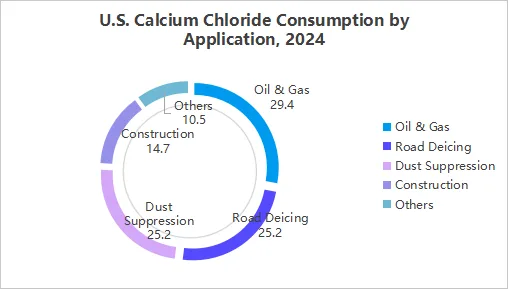
The United States is the largest calcium chloride market in North America. Based on industry estimates, U.S. calcium chloride consumption reached approximately 1.05 million metric tons in 2024. Oil and gas accounted for about 294,000 metric tons, while road deicing and dust suppression each represented approximately 252,000 metric tons. Construction accounted for approximately 147,000 metric tons.
Oil and Gas Is a Major Application
In 2024, the U.S. oil and gas industry consumed approximately 294,000 metric tons of calcium chloride. Calcium chloride is used in oilfield chemicals such as drilling fluids, where it is used to increase fluid density and control clay swelling during drilling operations.
Major demand centers include the Permian Basin, Appalachian Basin, and Gulf of Mexico. As a result, changes in U.S. drilling activity can directly affect demand for industrial calcium chloride.
Road Deicing and Dust Control Provide Stable Demand
In 2024, demand for each of these applications was approximately 252,000 metric tons; together, they form the core of U.S. calcium chloride consumption, with deicing demand exhibiting distinct seasonality. Northern regions of the United States and Canada, where heavy snowfall is common, represent the largest markets for calcium chloride deicing products. According to statistics, the number of aircraft deicing operations at Chicago O’Hare International Airport fluctuates between 6,000 and 10,000 each winter, directly reflecting the impact of climate on consumption volumes. In contrast, demand for road dust suppression and road stabilization is more consistent, with primary applications in highways, mining areas, and construction sites.
Canada: A Stable Market Driven by Deicing
Canada is another important destination market for calcium chloride suppliers in North America, with winter road maintenance representing a major source of demand.
In 2024, Canada's calcium chloride imports reached approximately 127,923 metric tons, valued at $45.08 million. The United States supplied 97,604 metric tons, while China supplied 18,808 metric tons. U.S. shipments accounted for approximately 76% of Canada's import volume, while China's share was about 15% by volume. The Canadian market is strongly influenced by winter weather and municipal road-maintenance budgets. Calcium chloride is also used in agriculture, construction, dust control, and industrial applications, providing additional demand outside the winter season.
Mexico: Dual Drivers of Oil and Gas and Industrial Demand
Compared to the United States and Canada, Mexico’s calcium chloride market is smaller, but it exhibits certain characteristics of regional trade. In 2024, Mexico imported approximately 6,337 metric tons of calcium chloride, valued at $4.68 million. China supplied about 4,814 metric tons, worth $1.57 million, making it the largest supplier by volume.
Demand for calcium chloride in Mexico primarily stems from oil and gas drilling (in the Gulf of Mexico and northern onshore fields), construction (as a concrete accelerator and for pavement stabilization), and dust control in mining operations. As a member of the USMCA, Mexico enjoys zero tariffs on calcium chloride imports from the United States and Canada, while standard-grade products imported from China remain price-competitive. Consequently, Mexico is not only a consumer market for calcium chloride but also an integral part of the North American regional supply chain.
Dihydrate Calcium ChlorideAccounts for the Largest Market Share
The North American market mainly uses three product forms: liquid calcium chloride, Dihydrate Calcium Chloride, and anhydrous calcium chloride.
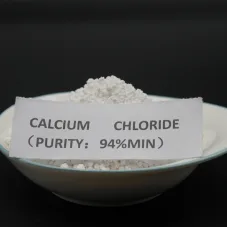

According to publicly available industry research,dihydrate calcium chloride is the product type with the largest market share in North America.
Dihydrate calcium chloride offers good storage and transportation convenience and is widely used in road dust suppression, road stabilization, and drilling fluids.
Liquid calcium chloride, on the other hand, is better suited for applications requiring rapid dissolution and direct spraying, such as road deicing and dust suppression.
Anhydrous calcium chloride is primarily used in industrial processing sectors with high requirements for hygroscopicity, drying, and moisture control.
Therefore, different product forms correspond to different end-use applications, and suppliers need to match product specifications to the end use when developing clients in North America.
China Is an Important Supply Source for the North American Market
China’s Production Capacity and Export Scale
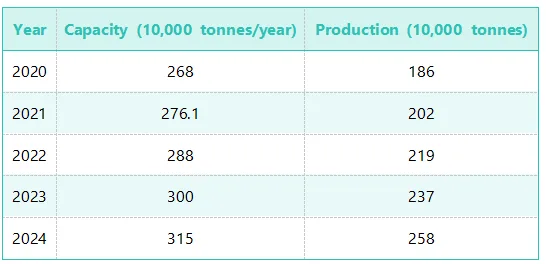
China is the world’s largest producer and exporter of calcium chloride, as well as one of the key sources of imports for the North American market.From 2020 to 2024, China’s calcium chloride capacity expanded from 2.68 million metric tons per year to 3.15 million metric tons per year, accounting for over 51.5% of the global total;Production increased from 1.86 million metric tons in 2020 to 2.58 million metric tons in 2024, representing a CAGR of 8.4%, significantly higher than the global average of 3.6%. Consumption grew in tandem to 2.41 million metric tons, with a CAGR of 8.8%. China’s annual calcium chloride production is nearly 2 million metric tons, with major production regions including Shandong, Hebei, and Jiangsu.
Table. China Calcium Chloride Capacity and Production, 2020–2024
China’s Position in the Global Export Landscape
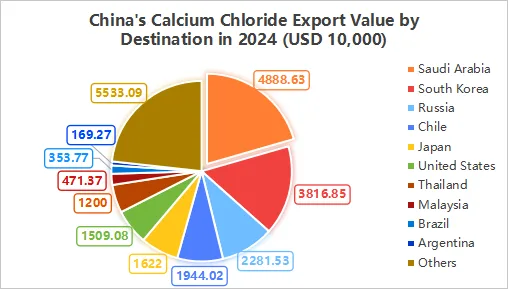
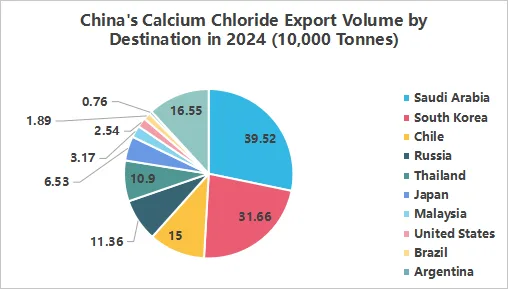
According to WITS trade data under HS 282720, China exported approximately 1.399 million metric tons of calcium chloride in 2024, with an export value of approximately $237.9 million. This corresponds to an average export value of roughly $170 per metric ton.With a 42.5% share of global exports, China firmly held the top position worldwide. In terms of the global export landscape, China’s export value of $308 million far exceeded that of the second-ranked Netherlands ($51.3 million) and the third-ranked United States ($38.9 million). With a trade surplus of $305 million, China was the country with the largest surplus in global calcium chloride trade.
China's Role in the North American Calcium Chloride Supply Chain
China is a major supplier to the North American calcium chloride markets.
United States
In 2024, China exported approximately 25,435 metric tons of calcium chloride to the United States, with a total export value of $15.09 million. China was the largest supplier of calcium chloride to the U.S. market, ahead of the European Union, which exported products valued at $8.49 million, followed by the Czech Republic at $7.55 million, Canada at $7.52 million, and Mexico at $5.54 million.
Canada
In 2024, China exported approximately $3.37 million worth of calcium chloride to Canada, accounting for around 3% of China’s total calcium chloride exports. The Canadian market has traditionally been dominated by U.S. suppliers, which accounted for approximately 76% of Canada’s calcium chloride imports. Chinese suppliers have gradually expanded their presence, particularly in the standard-grade industrial calcium chloride segment, where their competitive pricing has helped them capture around 15% of the market.
Mexico
In 2024, China exported approximately $1.1 million worth of calcium chloride to Mexico, making it the second-largest source of calcium chloride imports for Mexico, trailing only Germany ($1.91 million) and surpassing the United States ($813,000).
The main competitive advantage of Chinese calcium chloride in the North American market comes from its lower production costs. China’s calcium chloride industry benefits from large-scale chemical production networks, including calcium chloride recovery from soda ash and related chemical processes, resulting in comprehensive production costs significantly lower than those of European and American manufacturers that rely on natural gas as an energy source.And 85% of these exports were industrial-grade products, with an average price of only $412 per metric ton; In contrast, the average export price from the EU was as high as $985 per metric ton, and from Japan, $1,120 per metric ton, highlighting China’s price competitiveness in standard-grade products and the value chain gap in high-purity products.
2025–2033: Moderate Growth Expected in North America
The North American calcium chloride market is expected to maintain moderate growth through 2033.
IMARC projects market volume to increase from approximately 2.44 million metric tons in 2024 to 2.82 million metric tons by 2033, equivalent to a CAGR of about 1.6%. The growth will vary by application.Road deicing demand will continue to depend heavily on winter weather and public infrastructure spending. Oil and gas demand will be influenced by drilling activity, while construction, mining, dust control, and industrial processing will provide additional sources of consumption.The market is therefore more likely to experience steady expansion than rapid growth.
Buyers are increasingly focusing on suppliers that can provide consistent quality, reliable delivery, appropriate product forms, and competitive total delivered costs.
Conclusion
The United States remains the primary consumer market for calcium chloride in North America, with the oil and gas sector, road deicing, and road dust suppression constituting the main sources of demand. The Canadian market is dominated by winter de-icing demand, while Mexico is driven more by the oil and gas sector, construction, and industrial applications. In the future, demand for calcium chloride in North America is expected to maintain moderate growth.
In terms of the supply landscape, China is the United States’ largest source of calcium chloride imports, Mexico’s second-largest source, and holds approximately a 15% share of the Canadian market. Although China’s exports consist primarily of industrial-grade products (with an average price of approximately $412 per metric ton)—which lag behind the high-purity products from the European Union ($985 per metric ton) and Japan ($1,120 per metric ton)—its cost advantages and production capacity give Chinese products an irreplaceable competitive edge in the North American standard-grade market.