
In the fourth quarter of 2025, the U.S. caustic soda market is expected to enter a period of adjustment, with different trends emerging between caustic soda flakes and caustic soda pearls. Compared to liquid caustic soda, caustic soda flakes and caustic soda pearls are better suited for long-distance transportation and therefore account for a higher proportion of international trade. However, there are significant differences between the two in terms of application areas and market positioning. Considering comprehensive supply, demand, and trade factors, the U.S. caustic soda flakes market is expected to face significant pressure in Q4 2025, while the caustic soda pearls market is likely to remain relatively stable.
Caustic Soda Flakes Market: Increased Supply Competition Continues to Weigh on Prices
Price Forecast: Weak Export Market Weighs on Prices
As of the end of September 2025, the spot export assessment price for caustic soda on the U.S. Gulf Coast stood at USD 390–440/dmt FOB U.S. Gulf Coast. This marks the third consecutive week of stability, though market activity remains light, with European importers serving as the primary source of spot demand. During the same period, the contract price for caustic soda from the U.S. Gulf Coast (September) was $600–635 per short metric ton (FOB USGC).
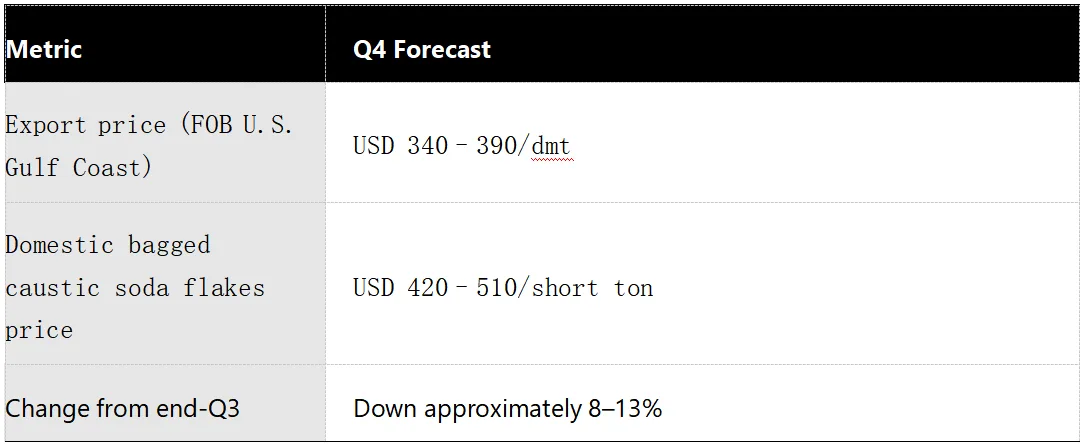
Based on export price levels and demand trends at the end of Q3, U.S. caustic soda flakes export prices in Q4 are expected to decline to the USD 340–390/dmt FOB U.S. Gulf Coast, representing a drop of approximately 10–13% from the end-Q3 level. Typical prices for domestic caustic soda flakes (bagged, FOB U.S. ports) range from $420 to $540 per short ton; actual Q4 transactions will tend toward the lower end of this range, with some spot deals potentially falling below the lower limit.
Two factors are driving the expected decline.First, the export market lacks incremental demand; the Pacific Basin arbitrage window has closed; and ample Brazilian inventories have dampened spot purchasing interest, with spot quotes for U.S. cargoes ranging only between $20 and $30 per dry metric ton, resulting in a significant gap in price expectations between buyers and sellers. Second, year-end inventory reduction pressure is mounting; to avoid carrying high-priced inventory into 2026, suppliers are expected to increase shipments through the spot market in Q4.
Increase in Imported caustic soda flakes
The supply structure of solid caustic soda in the United States has undergone a structural shift in 2024. According to IndexBox data, domestic consumption of solid caustic soda in the U.S. remained stable at 439,000 metric tons in 2024, but domestic production fell to 417,000 metric tons. The supply-demand gap drove imports to surge by 49% to 39,000 metric tons, primarily from Thailand, Taiwan, and India. As the primary form of solid caustic soda, the supply structure for caustic soda flakes is shifting from “primarily self-sufficient” to “supplemented by imports.” This trend continued into 2025: as of Q3, U.S. imports of solid caustic soda remained at a high level, with Thailand and India continuing to expand their market share in the U.S. market.
The key variable on the supply side in Q4 is year-end destocking. In its report at the end of September 2025, Argus noted that suppliers prioritized inventory management during this period to prepare for an anticipated window of constrained spot supply. In Q4, suppliers are expected to accelerate destocking efforts, increasing pressure on spot supply.
Weak End-User Demand
The core downstream applications for caustic soda flakes include pulp and paper, alumina refining, water treatment, and chemical processing.
Pulp and paper is a major consumption sector for caustic soda in North America, accounting for approximately 28%. In 2025, this industry faces structural pressures: efficiency improvements at new pulp mills and increased caustic soda recovery rates are gradually replacing demand for virgin caustic soda, and some pulp mills in the U.S. Southeast have already announced closures. Caustic soda procurement in the pulp and paper industry is expected to remain weak in Q4.
In the alumina sector, the industry is affected by global aluminum price volatility and profit pressures; refiners are adopting a more cautious procurement approach, focusing primarily on contract volumes and reducing spot purchases.
Demand from chemical processing and water treatment remains relatively stable; however, the overall weakness in U.S. manufacturing has not improved, and downstream buyers are generally adjusting their procurement schedules in line with reduced operating rates.
Caustic Soda Pearls Market: Premiums Narrow, but Downstream Structure Shows Greater Resilience
Price Forecast
In the international market, caustic soda pearls typically commands a premium of approximately 5–15% over caustic soda flakes, reflecting the additional costs associated with the granulation process. According to CIF data for global ports as of early October 2025, the CIF price for caustic soda flakes at the Port of New York was $658 per metric ton, while caustic soda pearls was $723 per metric ton—a price spread of about 9.9%, which has narrowed significantly from the year’s high (10–15%).
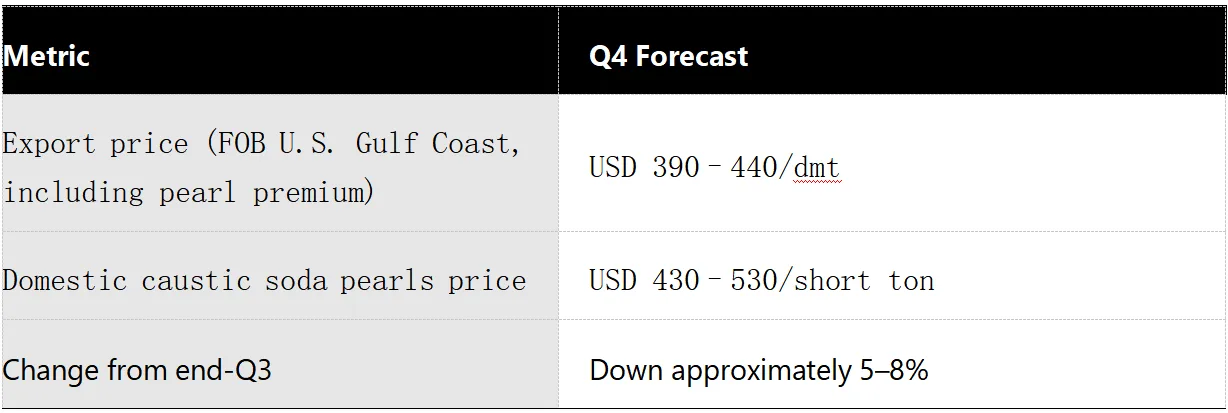
In Q4, U.S. caustic soda pearls export prices are expected to range from USD 390–440/dmt FOB U.S. Gulf Coast, while domestic prices are projected to range from USD 430–530/short ton. The price spread relative to caustic soda flakes is expected to narrow further to 6–10%.
The primary reason the price decline for caustic soda pearls is expected to be slightly smaller than that for caustic soda flakes lies in differences in downstream market structures. Due to its low dust content, good flowability, and long shelf life, caustic soda pearls has inelastic demand in sectors such as pharmaceuticals, food processing, and automated water treatment—areas where caustic soda flakes is difficult to substitute. In Q4, the food processing and pharmaceutical sectors will maintain stable demand for high-grade caustic soda and will not experience the pronounced slowdown seen in the pulp and paper and alumina industries. However, demand for caustic soda pearls in chemical processing and general industrial sectors is also being dragged down by weakness in the manufacturing sector; therefore, caustic soda pearls will find it difficult to completely avoid a price decline.
Increased Imports of caustic soda pearls, Limited Supply Elasticity
caustic soda pearls accounts for a smaller share of the U.S. solid caustic soda market than caustic soda flakes, and reliance on imports continues to rise. Thailand, Taiwan, and India are the primary sources of solid caustic soda imports, with caustic soda pearls gradually gaining market share. Competition between imported and domestically produced caustic soda pearls will intensify further in Q4, putting downward pressure on domestic caustic soda pearls pricing.
However, the supply elasticity of caustic soda pearls is lower than that of caustic soda flakes. Because caustic soda pearls production facilities are relatively complex, supply adjustments are typically constrained by equipment and customer structure. When demand weakens, suppliers tend to manage inventory by reducing operating rates rather than cutting prices significantly. This characteristic suggests that the price bottom for caustic soda pearls may occur earlier than that for caustic soda flakes.
Supported by Inelastic Demand, with Pronounced Structural Advantages
The core downstream applications of caustic soda pearls are sharply differentiated from those of caustic soda flakes:
Pharmaceutical and food-grade applications represent the most inelastic sources of demand for caustic soda pearls. These industries have high requirements for product purity and operational safety, and the low-dust characteristics of caustic soda pearls make it the preferred form. Purchasing in this sector is expected to remain stable in Q4.
Automated dosing systems represent another area where caustic soda pearls holds a structural advantage. Its excellent flowability makes it suitable for screw feeders and pneumatic conveying systems, making it difficult to replace with liquid caustic soda or caustic soda flakes in large-scale water treatment plants and continuous chemical production facilities.
Regarding storage requirements in tropical or high-humidity environments, caustic soda pearls has lower hygroscopicity than caustic soda flakes and offers superior storage stability in regions with high temperatures and humidity, making it irreplaceable in certain export markets.
Conclusion
In Q4, caustic soda flakes faces a triple pressure of “weak export demand + year-end destocking + weak demand from both the pulp and paper and alumina sectors.” As of early October, export prices from the U.S. Gulf of Mexico had remained at a relatively low level of USD 390–440/dmt FOB U.S. Gulf Coast for three consecutive weeks, and destocking sales are expected to further depress spot prices in Q4. caustic soda flakes prices will continue to face significant downward pressure in Q4.
Supported by relatively stable demand from pharmaceutical, food processing, and automated dosing applications, caustic soda pearls are expected to experience a smaller price decline than caustic soda flakes in Q4.The premium of caustic soda pearls over caustic soda flakes has narrowed from 10–15% earlier this year to 6–10%, but the premium will not disappear. In the medium to long term, the penetration rate of caustic soda pearls in high-end downstream sectors continues to rise, and this trend will persist through Q4 and into 2026.
A common risk for both products is that U.S. manufacturing demand may weaken further in Q4. If this trend persists into Q1 2026, the price floor for both caustic soda flakes and granules could be lower than currently expected. However, due to the inelasticity of downstream demand, price volatility for granules is expected to be less pronounced than for flakes.