
Market Overview
The US caustic soda market entered February 2024 with a relatively balanced fundamental picture. Prices were supported by stable demand and maintenance-related supply constraints along the US Gulf Coast, while the restart of OxyChem’s Ingleside complex improved availability. Braskem reported that US caustic soda prices increased by about 2% in the first quarter from the previous quarter, reflecting stable demand and limited supply caused by maintenance outages along the Gulf Coast.
Supply Recovers Along the Gulf Coast
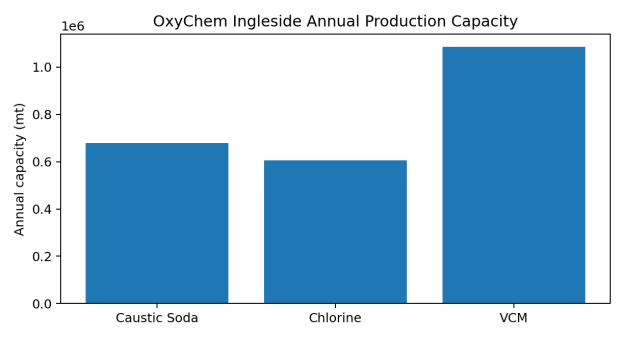
A key development during February was the restart of caustic soda and VCM production at OxyChem’s Ingleside, Texas, facility following scheduled maintenance. The facility had been shut down for maintenance since November 2023 and resumed operations in February. Its annual capacity is approximately 678,000 mt of caustic soda, 605,000 mt of chlorine and 1.085 million mt of VCM. The restart returned substantial chlor-alkali capacity to the Gulf Coast supply chain and reduced near-term availability concerns.
Chart 1. OxyChem Ingleside annual production capacity.
Demand Remains Mixed
Downstream demand remained uneven across the US industrial economy. Caustic soda consumption is closely linked to pulp and paper, alumina, water treatment and chemical manufacturing. Buyers continued to manage inventories carefully after a softer 2023 demand environment, limiting the potential for a sharp demand-led price increase. Because chlorine and caustic soda are co-products, producer operating decisions are also influenced by chlorine and downstream vinyl-chain economics.
Asian Supply Provides a Global Reference
Developments in China remained relevant to the broader market. Chinese operating rates were relatively high entering February, while domestic demand was seasonally weaker around the Lunar New Year. Chinese market reports indicated a caustic soda operating rate of 87.57% at the beginning of February and liquid caustic soda inventories of about 295,300 mt at the end of January. These figures pointed to substantial production availability in Asia, although lower inventories provided some short-term support.
For US buyers, Asian prices are less directly influential than Gulf Coast domestic supply, but international pricing remains important for arbitrage, export economics and global trade flows. Freight disruption and longer shipping routes also continued to affect the competitiveness of long-haul cargoes.
Market Outlook
The February market was characterized by firm but controlled pricing rather than a clear demand-driven rally. Gulf Coast maintenance provided price support, while the Ingleside restart improved domestic availability. Key variables for the coming months include Gulf Coast operating rates, downstream pulp and paper and chemical demand, alumina-related consumption, domestic inventories, export economics and international freight.
If downstream demand strengthens while producer operating rates remain disciplined, the US market could tighten later in the spring. Conversely, ample domestic production and competitive international supply would limit upside potential. For buyers, February favored a cautious procurement strategy focused on balancing near-term requirements with improving availability after maintenance.
Key Market Indicators
Sources
Braskem 1Q24 Results; Occidental/OxyChem corporate disclosures; ChemAnalyst, February 15, 2024; Chinese market reports supplied for this commentary.