
In the third quarter of 2025, the global calcium chloride (CaCl₂) market showed significant regional divergence. Prices in South America declined sharply as increased volumes of competitively priced Chinese material entered the market, while North American prices remained stable, supported by seasonal inventory preparation ahead of winter de-icing demand.
South American Market: Brazilian Prices Decline 10.6% QoQ as Chinese Supplies Gain Market Share
According to Q3 market data from major price monitoring agencies, the South American calcium chloride market faced significant downward pressure in the third quarter. Brazil’s calcium chloride price index fell 10.6% quarter-over-quarter, with the quarterly average price at approximately $186 per metric ton (CFR Santos)—a marked decline from the approximately $207 per metric ton recorded in Q2—making it the region with the most pronounced price drop globally.
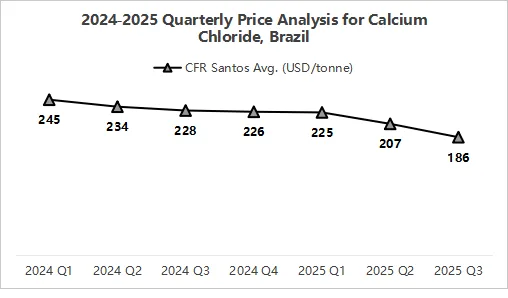
The price decline was mainly driven by three factors:
A massive influx of low-priced supplies from China. Both northern and southern South American markets rely heavily on imports, mainly from Chinese calcium chloride suppliers.In China, calcium chloride is largely produced as a by-product of chlor-alkali operations, benefiting from large-scale production capacity and relatively low manufacturing costs. In 2024, China exported approximately 3,537 metric tons of calcium chloride to Brazil, with an export value of about $18.9 million; Brazil has become one of the key markets for China’s calcium chloride exports. In September 2025, China’s total calcium chloride exports to Latin America reached 6,227 metric tons, with an average price of approximately $152 per metric ton—significantly lower than the $240–$350 per metric ton price range for de-icing and construction-grade products in the North American market. As Chinese export volumes to South America increased, additional cargoes arriving at the Port of Santos placed downward pressure on CFR transaction prices.
Demand for road de-icing applications is extremely limited in Brazil. Due to the mild winter climate in Brazil and most South American countries, the demand for road de-icing is limited. Demand is mainly concentrated in industrial applications, including oil and gas drilling fluids, mining, dust suppression, infrastructure, and agriculture. With limited market capacity, a surge in imports can easily lead to oversupply.
Elevated interest rates have reduced incentives for inventory accumulation. Brazil’s high-interest-rate environment has increased importers’ financing costs and inventory holding costs. Importers have generally abandoned the practice of locking in supplies in advance and stockpiling for extended periods, opting instead to purchase small batches on an as-needed basis. The decline in forward orders is further suppressing prices.
North American Market: Stable Pricing Supported by Seasonal De-icing Demand
In September, prices in the North American calcium chloride market showed minimal fluctuation, and the U.S. market operated steadily overall. According to market data, U.S. calcium chloride prices in June 2025 rose by 1.45% month-over-month, and the U.S. calcium chloride price index for Q3 fell only slightly by 0.39% month-over-month. with the average transaction price at approximately $344.33 per metric ton. Prices remained substantially higher than in Brazil, reflecting stronger seasonal demand fundamentals and a more balanced supply structure.
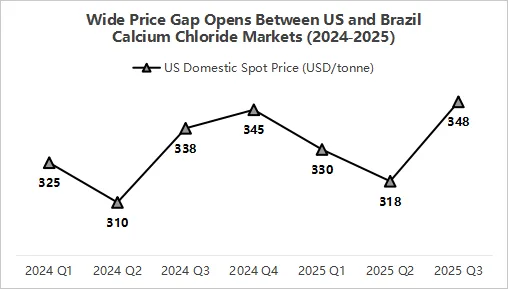
The North America calcium chloride market is primarily driven by winter de-icing demand. The third quarter is when producers and distributors stock up for the winter, and municipal procurement gradually begins, creating a firm baseline demand that effectively offsets the impact of weakening demand from the construction industry. This is the key reason why prices in North America have remained stable.
Domestic U.S. production supplies approximately 60%–70% of North American demand, with major producers including OxyChem and Tetra Technologies. In terms of imports, Mexico and China are the primary sources of calcium chloride for the United States, with Mexico accounting for about 39% of U.S. imports and China for about 30%. Supplies of calcium chloride dihydrate (74%, 77%) and anhydrous calcium chloride (94%) are ample, and products in various forms—such as flakes, granules, and powder—can meet the needs of multiple sectors, including construction, oil and gas, de-icing, and food processing. Consequently, prices in the North American market have not experienced a significant decline despite the increase in global supply.
China Supply: Expanding Capacity Drives Export Competition
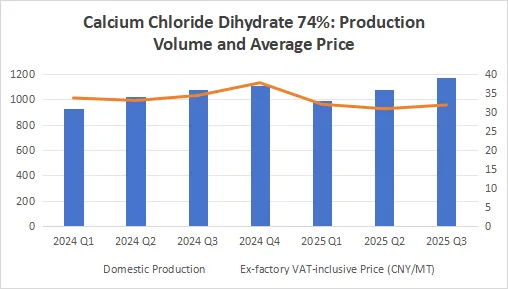
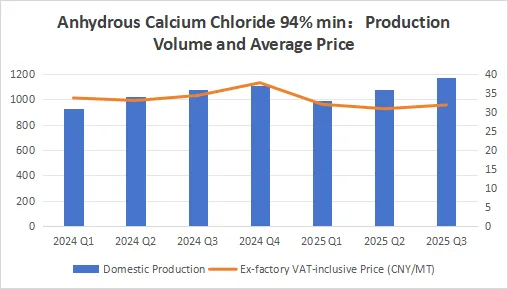
China is the world’s largest producer and exporter of calcium chloride. In the first half of 2025, China’s calcium chloride output reached 1.8175 million metric tons, up 9.94% year-over-year, as production capacity continued to expand. Domestic market prices came under pressure, with the average price falling to 672 yuan per metric ton by the end of June—a year-over-year decline of 25.33%—marking a four-year low. In recent years, as the salt chemical industry chain has matured and the supply of by-products such as hydrochloric acid and limestone has stabilized, Chinese companies have gained a strong cost advantage.
On the export front, domestic downstream demand for road de-icing and dust suppression seasonally weakened in Q3, leading to rising inventory pressures at domestic plants. Producers increased export activity and expanded their presence in Latin American markets, continuing to supply additional volumes to South American countries such as Brazil. From January through May 2025, Chinese calcium chloride exports totaled 502,300 metric tons, a 2.54% year-over-year increase; however, the export value decreased by 10.56% year-over-year. Export prices for industrial-grade, anhydrous, flake, and granular calcium chloride remained highly competitive, with Chinese calcium chloride exports reaching multiple markets, including Southeast Asia, South America, the Middle East, Europe, and North America.
Outlook
As we enter the fourth quarter, the North American market will gradually enter the peak season for winter de-icing demand, which is expected to provide support for prices. In South America calcium chloride, where demand has a relatively low ceiling, prices tend to fall rapidly once external supply increases significantly; the global calcium chloride price trend is consistent with this market dynamic.Therefore, the market will continue to face pressure from low-priced Chinese supplies in the coming period, and there is insufficient momentum for a short-term price rebound. Chinese suppliers will maintain a competitive edge in South America calcium chloride market, but in North America and Europe calcium chloride market will depend more on weather, inventory cycles, and local supply conditions rather than being solely influenced by low-priced Asian supplies. Purchasers should monitor changes in regional price differentials and choose calcium chloride grades based on specific application requirements,such as industrial calcium chloride flakes, Anhydrous Calcium Chloride, and Dihydrate Calcium Chloride,while comprehensively evaluating supply stability and landed costs.