
In October 2026, the U.S. sodium nitrite market showed a firmer trend, supported by seasonal fourth-quarter procurement from food processors, higher import logistics costs and rising upstream raw material expenses. These factors contributed to upward pressure on suppliers’ offers and shaped buyers’ procurement strategies. However, export availability from China remained broadly stable, with no evidence of widespread supply constraints in the U.S. market. The price gains were therefore driven primarily by seasonal demand and elevated import costs, rather than any significant disruption to supply.
Seasonal Procurement from Food Processors Supports Market Demand
At the beginning of October, the U.S. food processing sector entered its seasonal fourth-quarter purchasing cycle. As a key input for meat curing and food preservation, sodium nitrite demand is closely linked to processed meat production schedules. With the year-end holiday season approaching, some meat processors maintained planned curing output and secured raw materials in advance, providing underlying support to the U.S. sodium nitrite market.
According to a market analysis published by ChemAnalyst on Oct. 26, U.S. processed meat manufacturers continued to follow established fourth-quarter purchasing schedules, sustaining market activity. However, the demand improvement did not trigger large-scale restocking. Most buyers focused on covering immediate production requirements, avoiding excessive inventory accumulation amid uncertainty over prices and transportation costs.
Demand from the pharmaceutical and water treatment sectors remained broadly stable. Manufacturers in these industries continued to purchase sodium nitrite on an as-needed basis, maintaining baseline consumption without generating significant incremental demand.
Chinese Export Availability Remains Stable Amid Persistent Logistics Pressures
Chinese supply availability remains a key factor shaping the U.S. sodium nitrite import market. Market reports in October indicated that Chinese producers maintained broadly normal operating rates, with no significant widespread plant shutdowns or supply disruptions reported. Export availability across Asia therefore remained relatively ample.
However, sufficient supply at origin did not necessarily translate into lower-cost or timely deliveries to the U.S. market. In late September, successive typhoons disrupted operations at major Chinese ports, including Ningbo and Shanghai, resulting in temporary terminal closures, vessel bunching and longer berthing delays. According to a ChemAnalyst report published on Sept. 24, waiting times at some major Chinese ports reached up to 10 days, while freight rates for 40-foot containers from Shanghai to Houston increased from levels recorded in the second half of August.
These logistical constraints were reflected in U.S. import prices. ChemAnalyst data showed that the CFR Houston price of sodium nitrite rose 19.30% week over week to $680/mt in the week ended Sept. 18, 2026, while Chinese domestic prices remained relatively stable over the same period. The divergence suggests that the increase in U.S. prices was driven primarily by higher freight costs, shipping delays and rising landed costs, rather than an equivalent upward movement in prices at origin.
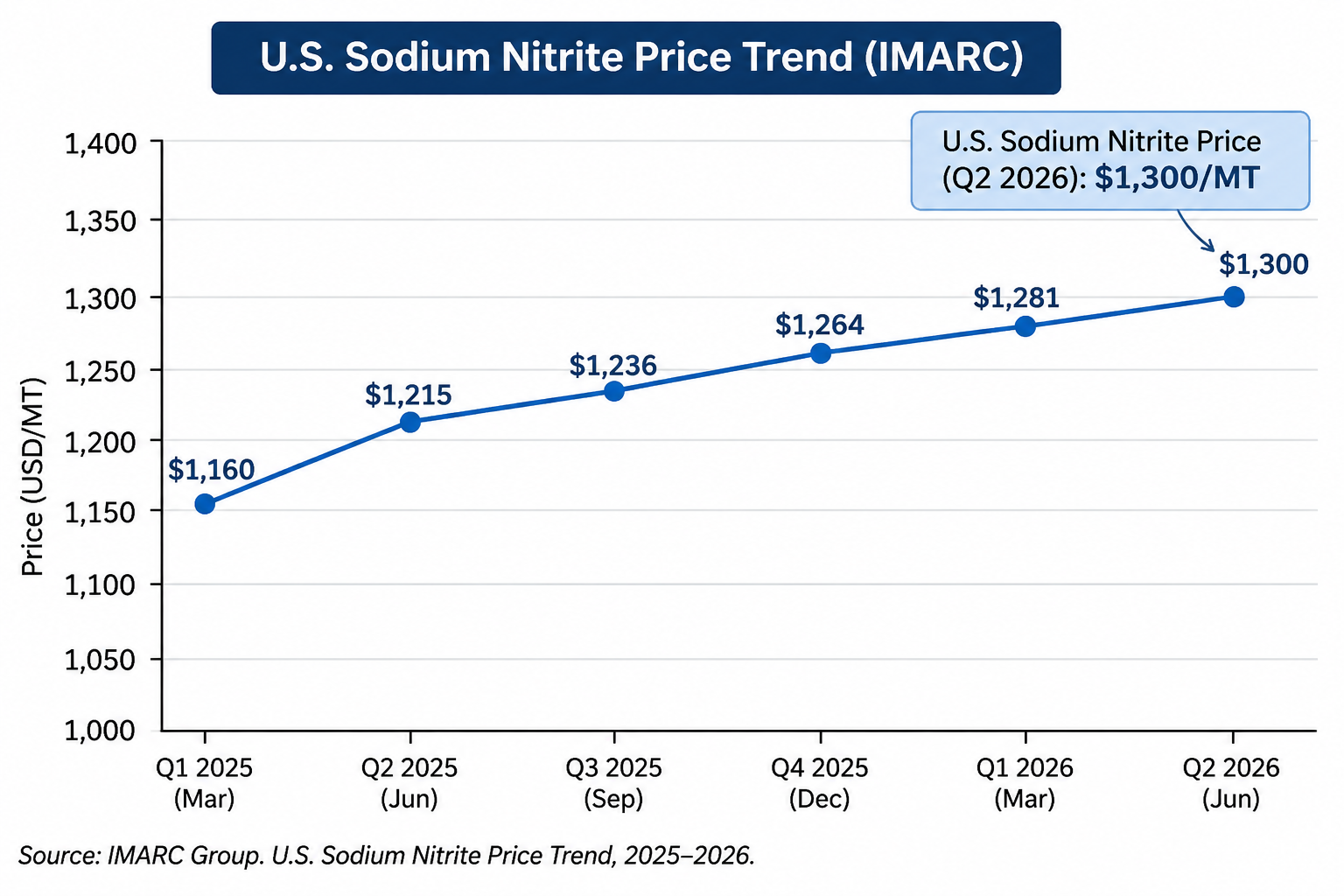
At the start of October, residual port congestion and shipping adjustments surrounding China's National Day holiday continued to influence import planning. For U.S. buyers dependent on Chinese material, shipping reliability, transit times and overall landed costs remained central considerations, despite relatively ample export availability.
U.S. Antidumping Measures Reshape the Sodium Nitrite Import Landscape
Trade policy also remained a factor influencing the U.S. sodium nitrite market in October. On Sept. 16, 2026, the U.S. Department of Commerce (DOC) announced the final results of its administrative review of anti-dumping duties on Indian sodium nitrite imports, covering the period from Feb. 1, 2024, to Jan. 31, 2025.
The final determination assigned Deepak Nitrite Limited a weighted-average dumping margin of 0.00%, while Kronox Lab Sciences Pvt. Ltd. and Kutch Chemical Industries Ltd. received margins of 42.76% each. The same 42.76% rate was maintained for companies not individually examined. Meanwhile, the DOC terminated the review with respect to three companies: Buradon, Palvi Industries and Lotus Global.
The findings highlight substantial differences in the applicable trade measures for individual Indian exporters, indicating that imports from India are not subject to a uniform anti-dumping duty rate. For U.S. importers, the applicable duty exposure, supplier selection and associated import costs are therefore increasingly important considerations in sourcing decisions.
The differentiated duty treatment may provide Chinese suppliers with opportunities to compete in the U.S. market. However, any expansion in Chinese export volumes will depend on their price competitiveness, freight costs, delivery schedules and their ability to meet U.S. buyers' supplier qualification and certification requirements.
Feedstock Costs and Supply Conditions Influence Market Price Trends
Beyond demand and logistics, changes in upstream production costs also lent support to the U.S. sodium nitrite market in October. ChemAnalyst reported that soda ash availability remained relatively stable, limiting immediate cost pressure. However, higher ammonia and natural gas costs could add to production expenses for sodium nitrite manufacturers.
On the supply side, Chinese export availability remained broadly ample, while U.S. buyers continued to take a cautious approach to purchasing. These conditions suggest that the market lacked the fundamentals for a sustained and substantial price rally. Seasonal demand and elevated import costs continued to underpin suppliers' offers, although prices could face some downward pressure in November if holiday-related purchasing activity eases and Asian export availability remains sufficient.
Overall, the U.S. sodium nitrite market firmed in October 2026, supported primarily by seasonal fourth-quarter demand from food processors, higher import logistics costs and developments in trade policy. The outcome of India's anti-dumping duty review further differentiated the cost competitiveness of individual import sources, while stable Chinese production and export availability continued to provide an important source of supplementary supply to the U.S. market.
Sources: ChemAnalyst, IMARC Group, U.S. Federal Register – Antidumping Duty Review.
Customer Questions & FAQ
Common questions from international chemical buyers.
1What factors supported the U.S. sodium nitrite market in October 2026?
The U.S. sodium nitrite market was primarily supported by seasonal fourth-quarter procurement from food processors, higher import logistics costs and rising upstream production expenses. These factors contributed to firmer supplier offers, although stable Chinese export availability limited the potential for more substantial price increases.
2How did seasonal demand from the food processing industry affect sodium nitrite prices in the U.S.?
Demand from meat processors provided underlying support to the market as manufacturers prepared for increased production ahead of the year-end holiday season. However, most buyers focused on covering immediate production requirements rather than building substantial inventories, limiting the overall impact of seasonal demand on prices.
3Does China remain a major supplier of sodium nitrite to the U.S. market?
Yes. China remains an important source of sodium nitrite for the U.S. import market. In October 2026, Chinese producers maintained broadly normal operating rates, with export availability remaining relatively ample. However, shipping delays, port congestion and higher freight costs continued to affect the competitiveness of Chinese material in the U.S. market.
4Why did U.S. sodium nitrite import prices increase despite stable Chinese domestic prices?
The increase was primarily attributed to higher freight rates, port congestion and rising landed costs rather than significant price increases at the production end. In the week ended Sept. 18, 2026, the CFR Houston price of sodium nitrite increased 19.30% week over week to $680/mt, while Chinese domestic prices remained relatively stable.
5How do U.S. anti-dumping duties on Indian sodium nitrite affect import competition?
The U.S. Department of Commerce's September 2026 final review results established different dumping margins for individual Indian exporters. Deepak Nitrite Limited received a 0.00% margin, while Kronox Lab Sciences and Kutch Chemical Industries were assigned margins of 42.76%. These differences may influence sourcing decisions and create additional opportunities for competing suppliers, including Chinese exporters.