
In July 2024, the U.S. soda ash market remained supported by tighter supply conditions, despite subdued demand across key downstream sectors. Production disruptions and lower inventories provided some upward support to prices, while demand from the glass industry showed limited signs of improvement.
US Soda Ash Export Prices Rise in July
U.S. natural soda ash producers raised export prices at the start of July. American Natural Soda Ash Corporation (ANSAC) announced a $25/metric ton increase, effective July 1, for non-contract sales and sales subject to contractual price adjustment provisions. The increase was attributed to tighter global soda ash supply and stronger demand.
ANSAC, the export sales, marketing and logistics arm of U.S. natural soda ash producer Genesis Alkali, plays a key role in the international market. The United States benefits from substantial natural soda ash resources, supporting its position as a competitive supplier to overseas markets. Changes in U.S. export pricing can therefore influence international trade flows and procurement costs for import-dependent buyers.
The July price increase highlighted continued pricing support for U.S. suppliers amid a tightening global supply balance. For overseas buyers, higher U.S. export offers could translate into increased procurement costs and may affect sourcing decisions and regional trade flows.
Supply-Side Developments Support Market Prices
Supply-side conditions remained a key market driver in July. Weather-related events and operational issues disrupted some U.S. soda ash production, while transportation constraints and container availability continued to affect export market liquidity.
U.S. soda ash prices stabilized in the second half of July, with tighter supply, higher selling costs and limited inventories providing support. Hurricane Beryl also disrupted industrial activity in parts of the country, while flooding in Texas affected some glass manufacturing operations, adding uncertainty to both supply and downstream demand.
Tighter availability improved producers’ leverage in the spot market. However, with no material recovery in downstream demand, market participants remained cautious about the price outlook.
Glass Sector Remains a Key Source of Demand
The glass industry remained the largest end-use sector for soda ash in the U.S. Soda ash is widely used in flat and container glass production, where it lowers the melting temperature of silica. U.S. Geological Survey (USGS) data shows that glass accounted for approximately 45% of domestic soda ash consumption, followed by chemicals at around 29%, underscoring the importance of the glass sector to overall demand.
Activity in downstream industries such as construction, automotive and packaging will therefore remain an important indicator for U.S. soda ash demand. Stable glass production would help sustain consumption, while continued weakness in end-use markets could limit procurement and leave producers exposed to higher inventories and sales pressure.
In July, tighter supply conditions helped offset some of the downward pressure from subdued demand. However, the supply-side support was not strong enough to generate a significant demand-led increase in prices.
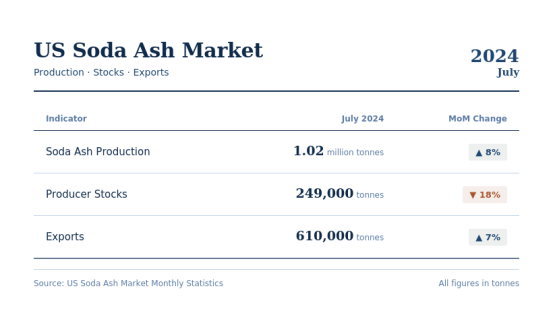
Production, Inventories and Exports Shape Market Balance
The U.S. soda ash market is also strongly export-oriented. The country’s abundant natural soda ash resources and established production base support significant export volumes, making U.S. supply an important component of global soda ash trade. As a result, changes in U.S. production, inventories and export flows can influence both domestic market conditions and the broader global supply-demand balance.
In July, tighter supply provided some support to U.S. soda ash prices. However, additional production capacity and subdued demand in other regions continued to weigh on the broader international market. U.S. producers are therefore likely to remain focused on balancing domestic sales, export volumes and inventory levels as regional market conditions evolve.
Market Outlook Remains Dependent on Supply and Demand
In the near term, U.S. soda ash prices are likely to remain sensitive to supply availability, plant utilization, inventory levels and export demand. Glass production will remain a key indicator of underlying demand, while weather conditions, logistics and operating rates could affect short-term supply availability.
Overall, the U.S. soda ash market in July 2024 was supported by tighter supply and firmer export pricing, while downstream demand remained subdued. Into the second half of the year, the balance between supply availability and demand from the glass sector will remain central to the price outlook. For U.S. and overseas buyers, procurement decisions are likely to continue to reflect not only price, but also supply reliability, export logistics and contractual pricing terms.
Sources: American Natural Soda Ash Corporation (ANSAC), U.S. Geological Survey (USGS), ChemAnalyst and publicly available industry data.