
In the second quarter of 2026, prices in the U.S. calcium chloride market underwent a correction following a seasonal shift in demand, while the Chinese market remained at low levels amid increased production capacity and a seasonal lull in demand. The two markets moved in opposite directions, and the price spread between grades continued to widen. This article analyzes the price performance and supply-demand dynamics of the U.S. and Chinese calcium chloride markets in Q2.
U.S. Calcium Chloride Market: Seasonal Price Correction, Widening Grade-to-Grade Price Differentials
In June 2026, U.S. calcium chloride prices stood at approximately $395 per metric ton. According to ChemAnalyst data, the U.S. calcium chloride price index rose by 10.65% quarter-over-quarter in the second quarter of 2026, with an average price of approximately $398.33 per metric ton. Spot prices fell in June, dropping to $395 per metric ton.
The price trend for calcium chloride in 2026 rose then fell in a seasonal pattern. From the end of Q1 to the beginning of Q2, residual demand from the winter de-icing season continued to support prices; however, as June began, de-icing demand largely subsided, and summer construction and industrial demand had not yet fully taken over, leading to a natural price correction.
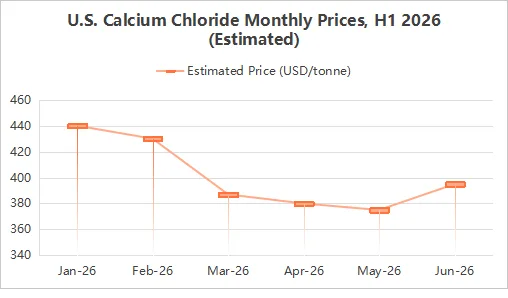
Domestic supply in the U.S. remained stable. Gulf Coast plants maintained normal production, natural brine supplies were ample, and distributor inventories gradually recovered. With no significant disruptions on the supply side,this set the stage for a steady price decline.
Export demand provided bottom-line support. According to CEIC data, U.S. calcium chloride export value reached $6.17 million in May 2026, up from $5.135 million in April. Notably, the $6.17 million figure is about 111% above the long-term average of $2.92 million from January 2001 to May 2026, indicating that current export levels remain historically high. Although this figure has declined from the peak of $40.98 million reached in June 2025, the continued presence of export demand has prevented prices from falling sharply.
Demand for high-purity calcium chloride is growing by 5–7% annually, and the price gap continues to widen.Calcium chloride prices vary significantly depending on grade and application. According to industry data, prices for de-icing and dust suppression applications are approximately $240 per metric ton, while those for construction range from $300 to $350 per metric ton, and prices in the oil and gas sector range from $450 to $550 per metric ton. In the food, agriculture, electronics, and chemical industries, prices can exceed $600 per metric ton and approach $1,000 per metric ton.
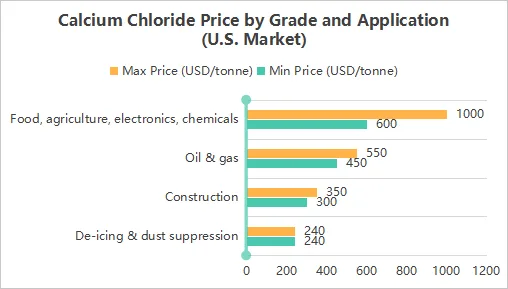
The high-purity grade is currently the fastest-growing market segment. According to an IndexBox report from June 2026, growth in the North American calcium chloride market is increasingly concentrated in the high-purity grade, which serves the electronics and electrical equipment supply chain; this segment is growing at an annual rate of 5–7%. Expansion in semiconductor manufacturing, grid modernization, and the replacement of transformer breather valves are driving concentrated demand for high-purity calcium chloride.
Contract prices for standard industrial-grade flaked calcium chloride (77–80% CaCl₂) typically range from $250 to $350 per metric ton. Domestic production in North America meets approximately 60–70% of regional demand, and the region continues to rely on imports for standard industrial-grade calcium chloride. Import competition from low-cost producers in China and the Middle East continues to put downward pressure on spot prices for commodity-grade calcium chloride.
China’s Calcium Chloride Market During the Same Period: Price Index Rises in Q2, but Spot Prices Come Under Pressure in June
Compared to the U.S. market, China’s calcium chloride market also saw a rise in the price index during the second quarter of 2026, but the spot market showed varying degrees of softening in June. In early June, the domestic market price for calcium chloride dihydrate (74% purity) was approximately RMB 780 /metric ton, while the market price for anhydrous calcium chloride (94% purity) was approximately 950 yuan/metric ton; ex-factory prices fluctuated within the range of 750–900 yuan/metric ton. By the end of June, the average market price of calcium chloride had fallen to 672 yuan per metric ton, a year-over-year decline of 25.33%, hitting a four-year low. Converted at the exchange rate for that month, the domestic price of dihydrate calcium chloride was only about $93–$116 per metric ton, creating a massive price differential of over $280 per metric ton compared to the U.S. market’s spot price of $395 per metric ton.
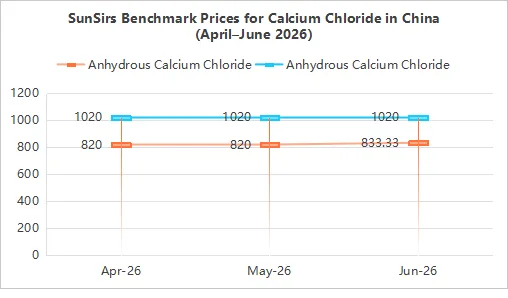
The primary reason for the sustained downward pressure on prices lies in the combination of capacity expansion and the off-season for demand. In the first half of 2025, national calcium chloride output reached 1.8175 million metric tons, a year-over-year increase of 9.94%, as production capacity continued to come online. Meanwhile, June marked the start of the summer off-season for demand, with de-icing needs largely concluded and construction and industrial demand yet to take over. Although falling prices for raw materials such as limestone and hydrochloric acid provided room for price declines, companies proactively cut prices to compete for market share. The resulting price drops far exceeded the decline in costs; in the final week of June, the industry’s gross profit was only 101.28 yuan per metric ton, a sharp year-over-year plunge of 81.05%.
The export sector also exhibited a trend of price-for-volume trade-off. According to data from the General Administration of Customs, the value of China’s calcium chloride exports in June 2026 was RMB 77.799, continuing to decline from May’s 81.633 million yuan. Given China’s high reliance on calcium chloride exports, the growth in export volume failed to offset the impact of falling prices, leaving the industry as a whole in the predicament of “increased production but no increase in profits.”
Conclusion
Overall, the Chinese calcium chloride market remained at the low end in Q2, in stark contrast to the U.S. market, which experienced a moderate correction following the end of the de-icing season. The core challenge in the Chinese market stems from overcapacity and seasonally weakening demand; there is little momentum for a price rebound in the short term, and export competition continues to intensify.