
On February 12, 2024, global chemical company Solvay announced that its Green River plant in Wyoming had completed its coal phase-out and switched to natural gas as its primary energy source, marking an important step in the transformation of the U.S. soda ash industry toward lower-carbon production.
The Green River plant uses abundant Wyoming trona resources to produce natural soda ash and sodium bicarbonate. These products are widely used in glass manufacturing, detergents, food processing, animal feed, flue gas treatment, solar glass, and lithium-ion battery supply chains.
The shift also reflects the broader move toward sustainable soda ash production in the global soda ash industry while reinforcing the competitive position of U.S. trona-based soda ash in international markets.
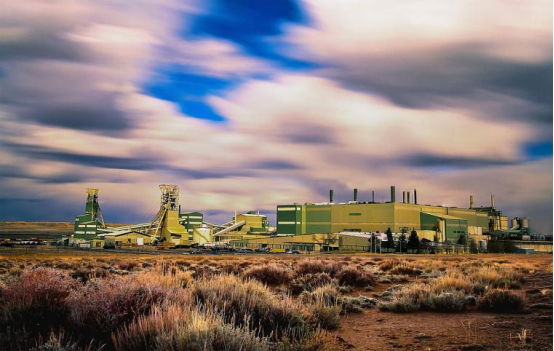
Figure 1. Solvay’s Green River soda ash plant in Wyoming, USA
Source: © Solvay
Wyoming Trona Resources Strengthen U.S. Natural Soda Ash Production and Export Competitiveness
The Green River region in Wyoming contains some of the world’s largest trona deposits and remains the backbone of U.S. natural soda ash production. Compared to traditional synthetic soda ash production, natural soda ash production offers advantages such as abundant local mineral resources, a simple production process, and lower energy consumption. These factors have enabled the U.S. natural soda ash industry to maintain long-term global cost competitiveness and become a key supplier in the international soda ash trade.
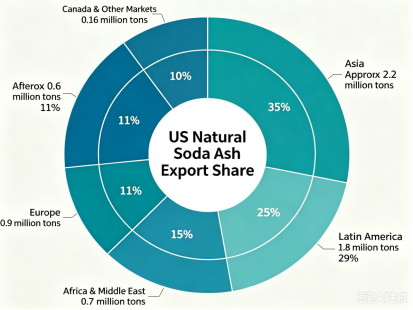
The U.S. natural soda ash industry currently has approximately 13.9 million metric tons per year of production capacity, with most capacity located in Wyoming. In 2023, U.S. soda ash production totaled approximately 11 million metric tons, of which about 55% was exported. In 2023, U.S. soda ash exports totaled approximately 6.2 million metric tons, making the United States one of the world’s leading suppliers of soda ash. Its export markets span Asia, Latin America, Europe, the Middle East, and other regions, with Asia and Latin America being the most important export destinations.
Solvay Reduces Carbon Emissions Through Low-Carbon Soda Ash Production
Solvay has also implemented emissions-reduction measures at its Green River operation. The Green River plant historically relied on coal for its energy needs. Following the upgrade, Solvay has replaced coal with natural gas as the plant’s primary energy source, reducing greenhouse gas emissions associated with the operation. Solvay expects the Green River plant to reduce greenhouse gas emissions by approximately 20% from 2021 levels by 2025, while increasing production by about 25%.
In the past, global competition in the soda ash industry primarily centered on three factors: production costs, product prices, and supply capacity. However, in recent years, procurement standards in the European and American markets have been shifting. Carbon emission levels, sustainable production capacity, and supply chain stability have gradually become key considerations in procurement decisions. Consequently, low-carbon production capacity is emerging as a new competitive factor for soda ash suppliers. Solvay’s energy transition not only reduces its environmental impact but also helps enhance the Green River plant’s long-term competitiveness in the international market.
Solvay Expands U.S. Soda Ash Production Capacity to Support Global Supply
In addition to its energy transition, Solvay has also continued to invest in its Green River facility in recent years. The company previously announced the resumption of its soda ash expansion plan at Green River, adding approximately 600,000 metric tons per year (600 kt/year) of capacity.
The expansion is designed to meet global demand for reliable and competitively priced soda ash while supporting Solvay’s lower-carbon production strategy.
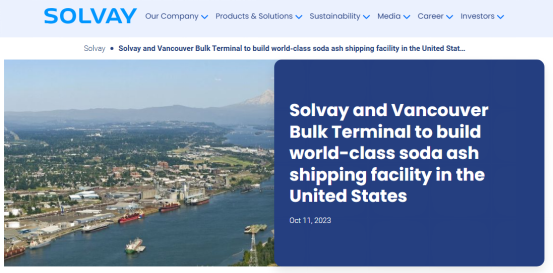
Solvay is also developing a new export terminal at the Port of Vancouver USA to support its expanded production capacity and strengthen its export infrastructure.
Glass and Renewable Energy Industries Drive Long-Term Soda Ash Market Growth
The glass industry remains the largest consumer of soda ash worldwide
Soda ash is a key raw material in glass manufacturing, which accounts for approximately 45 percent of global soda ash market demand. Major applications include flat glass (architectural glass, energy-efficient insulated glass) and container glass (food packaging, beverage packaging).
With the growth of the global construction, automotive, and packaging industries, the glass industry remains one of the largest consumer sectors for soda ash.
Solar Glass and Lithium Battery Industries Become New Growth Drivers for Soda Ash Demand
In addition to traditional applications, the new energy industry is emerging as a major source of growth for soda ash demand. In the photovoltaic glass sector, the projected growth in global solar power installed capacity is expected to generate approximately 10.3 million metric tons of soda ash demand annually between 2024 and 2030, as photovoltaic glass production requires large quantities of soda ash as a raw material; In the EV battery supply chains battery sector, soda ash is also one of the key raw materials for producing lithium carbonate. Although the lithium battery industry currently accounts for only 3% of global soda ash demand, it has become one of the fastest-growing sectors. As the EV battery supply chains and energy storage industries continue to develop, lithium resource processing and lithium carbonate production will continue to drive demand for soda ash.
Conclusion
Solvay’s completion of the energy transition at its Green River soda ash plant marks a new phase of development for the U.S. natural soda ash industry. By reducing coal use, expanding production, and investing in export infrastructure, U.S. soda ash producers are strengthening their position in global markets. Meanwhile, with the continued growth of the glass manufacturing, photovoltaic, and EV battery supply chains industries, global demand for soda ash will maintain a long-term upward trend. Future competition in the global soda ash market will depend not only on production capacity and pricing but also on supply reliability, production efficiency, and the ability of soda ash suppliers to provide lower-carbon solutions.