
In the first half of 2026, the global caustic soda market entered a period of increasing regional divergence, with supply conditions shaped by capacity expansion, downstream demand trends, energy costs, and logistics disruptions.
China remained the main source of new supply growth as continued chlor-alkali capacity expansion increased production availability. However, relatively weak domestic demand limited consumption growth, encouraging producers to rely more heavily on exports to balance the domestic market.
In North America, sufficient domestic capacity kept the market broadly supplied, although scheduled spring maintenance and geopolitical disruptions in the Middle East temporarily tightened spot availability and supported higher export prices.
European producers faced continued pressure from elevated electricity costs and long-term capacity rationalization. As a result, Europe remained structurally dependent on imported caustic soda supply.
Meanwhile, higher freight costs caused by geopolitical tensions reshaped global trade flows. Trans-Pacific and trans-Atlantic chemical shipping rates increased significantly between March and April, affecting delivered costs for international buyers. Latin America emerged as an increasingly important destination for solid caustic soda, particularly caustic soda pearls and flakes.
Overall, the global caustic soda market did not experience a uniform supply shortage in H1 2026. Instead, market conditions diverged significantly by region, production structure, logistics availability, and trade patterns.
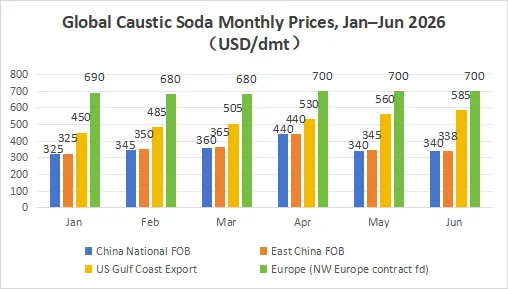
China Market: Capacity Expansion Continues While Domestic Demand Remains Under Pressure
China’s caustic soda market remained characterized by expanding supply and limited domestic demand growth during H1 2026. During the first half of the year, China added approximately 1.03 million metric tons/year of new caustic soda capacity, representing a year-on-year capacity increase of 2.1%. Domestic caustic soda output reached 21.69 million metric tons from January to June 2026, up 3.88% year over year. Supported by relatively strong chlorine demand, Chinese chlor-alkali producers maintained high operating rates. Industry operating rates remained around 83%-84%, significantly above the 60%-70% range observed in some Northeast Asian markets, including Japan, South Korea and Taiwan. The high utilization rate allowed Chinese producers to maintain strong production availability. However, downstream consumption growth remained insufficient to absorb additional supply.
The alumina industry remained the largest downstream consumer of caustic soda in China. Although new alumina capacity entered operation during H1 2026, overall sector profitability remained under pressure due to excess capacity. As a result, actual production growth was slower than initially expected, providing limited incremental demand support for caustic soda consumption. Other major downstream sectors, including pulp and paper, textile processing and viscose staple fiber, remained relatively stable but lacked strong growth momentum. With domestic demand unable to fully absorb additional production, China's caustic soda supply and demand balance remained under pressure. Domestic prices weakened during H1 2026. Average prices for 32% liquid caustic soda in Shandong declined significantly from the previous year, while solid products including caustic soda flakes and pearls also experienced downward pressure. Rising producer inventories encouraged exporters to seek overseas markets, making caustic soda exports an increasingly important outlet for balancing domestic supply.
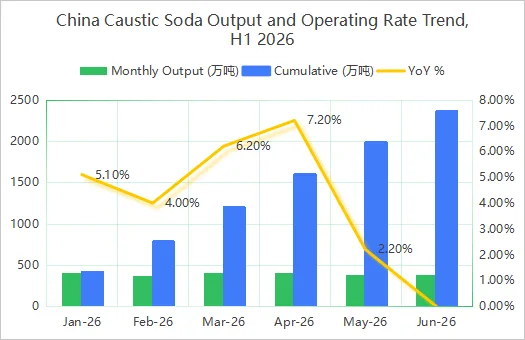
From March to May 2026, China's chlor-alkali industry entered its annual spring maintenance cycle. More than 9 million metric tons/year of caustic soda capacity (100% NaOH basis) underwent scheduled maintenance, temporarily reducing operating rates. Industry operating rates declined from above 86% at the beginning of the year to approximately 75%-78% during the maintenance period.
Several major facilities conducted planned shutdowns:
Despite the concentrated maintenance schedule, production remained relatively stable. China produced approximately 3.67 million metric tons of caustic soda in April, representing a year-on-year increase of 5.3%. In May, around 5 million metric tons/year of capacity entered maintenance, reducing operating rates to 81.2%, while weekly output declined to approximately 800,000 metric tons. The maintenance cycle provided temporary relief to domestic supply pressure, but it did not change the broader trend of expanding production capacity.
Chinese caustic soda exports remained strong during H1 2026. In Q1 2026, exports increased 45% year over year, with March shipments reaching a record high of 680,000 metric tons. Export bookings exceeded 40,000 metric tons/week for two consecutive weeks. By late March, most April export orders had already been secured. During the maintenance period, deliveries were mainly supported by existing inventories, and no major export delays were reported. The combination of high operating rates, limited domestic demand growth, and expanding production capacity continued to encourage Chinese producers to participate more actively in international markets.
North America Market: Ample Domestic Capacity, While Maintenance and Logistics Tighten Spot Availability
The North American caustic soda market remained fundamentally well supplied in H1 2026, supported by integrated chlor-alkali operations from major producers including Olin Corporation and Westlake Corporation. Unlike regions facing structural supply constraints, North America maintained sufficient domestic production capacity to meet most regional demand. However, short-term supply conditions tightened during the second quarter as multiple chlor-alkali producers carried out scheduled spring maintenance. During April and May 2026, planned maintenance reduced operating rates at several facilities, temporarily limiting availability of both liquid caustic soda and solid caustic soda. This supported a modest increase in U.S. Gulf Coast export prices. However, the impact of individual plant closures remained limited because regional supply availability remained adequate.
Between late 2025 and early 2026, Westlake permanently shut down a 120,000 metric tons/year caustic soda unit at its Lake Charles facility, while Olin permanently closed a 243,000 metric tons/year chlor-alkali unit at its Freeport site. Market feedback indicated that these closures had only a limited impact on the overall North American caustic soda market. ChemAnalyst reported in January 2026 that market participants considered the shutdowns to have a “minimal operational impact,” as U.S. supply remained sufficient and inventories were viewed as balanced. MRC also reported that the closures did not result in significant market disruption. U.S. caustic soda prices remained relatively stable in January, supported by normal logistics operations. Higher trucking costs provided additional support for delivered pricing. Approximately 60% of domestic chemical deliveries in the United States rely on trucking, making transportation availability an important factor in maintaining regional supply reliability.
The most visible impact on the North American market during H1 2026 came from international logistics rather than domestic supply losses. Following the escalation of geopolitical tensions in the Middle East, global chemical freight rates increased significantly between March and April. According to Argus assessments, U.S. Gulf Coast spot export prices reached approximately $510-$540/dry short ton in mid-April, higher than pre-conflict levels.
The increase was mainly driven by:
higher freight costs;
increased shipping risk premiums;
tighter global trade availability.
The price movement was therefore linked more closely to international logistics conditions than to domestic production losses. For international buyers, especially those sourcing from the U.S. Gulf Coast, the change highlighted the increasing importance of evaluating delivered costs rather than FOB prices alone.
Europe and Other Regions: Energy Costs Continue to Drive Capacity Rationalization
The European chlor-alkali industry continued to face structural pressure from high electricity costs during H1 2026. Energy remains one of the largest operating costs for chlor-alkali production because the electrolysis process requires significant electricity consumption. In 2025, the weighted average electricity price paid by European chemical producers was approximately €52/MWh higher than in the United States, compared with a difference of only €9/MWh in 2021. The widening energy cost gap weakened the competitiveness of European chlor-alkali operations. Some producers continued operating under compressed margins, while others accelerated permanent shutdowns, restructuring, or capacity relocation.
Between 2025 and H1 2026, several major chemical companies announced closures or reductions of European chlor-alkali capacity.
According to the European Chemical Industry Council (CEFIC), permanent chemical capacity closures in Europe totaled approximately 37 million metric tons between 2022 and 2025, representing around 9% of regional chemical production capacity. Although this figure covers the broader chemical industry rather than chlor-alkali alone, it reflects a wider trend of industrial capacity rationalization across Europe.
For the European caustic soda market, continued energy pressure and capacity reductions have increased dependence on imported supply. The region has increasingly become a structurally deficit market, requiring overseas shipments to balance domestic consumption.
H2 2026 Outlook
In the second half of 2026, the global caustic soda market is expected to remain characterized by relatively ample supply, uneven regional balances, and continued adjustments in international trade flows.
China is expected to remain the largest source of incremental caustic soda capacity expansion. Approximately 3.5 million metric tons/year of new capacity is planned for 2026. More than 1 million metric tons/year had already entered operation during H1, with additional capacity expected to gradually ramp up during the second half. However, domestic consumption growth is unlikely to fully absorb the additional supply. China’s downstream sectors, particularly alumina, pulp and paper, textile processing, and chemical manufacturing, are expected to provide limited incremental demand support. As a result, caustic soda exports will remain an important mechanism for balancing China's domestic supply. Nevertheless, export growth momentum may slow in H2 2026.During H1, Chinese exporters benefited from tight overseas supply conditions, elevated freight costs, and increased demand for alternative supply sources. As overseas chlor-alkali facilities complete maintenance cycles and regional supply conditions normalize, the arbitrage window for Chinese exports may gradually narrow. Latin America is expected to remain an important destination for Chinese solid caustic soda exports, particularly caustic soda pearls and flakes. Brazil and Mexico will continue to attract attention due to demand from alumina refining, mining, pulp and paper, and water treatment industries. However, long transit times, freight volatility, container availability, and import procedures will continue to limit large-scale replacement of traditional regional suppliers. Instead of replacing existing suppliers entirely, Latin American buyers are more likely to adopt diversified sourcing strategies. This means combining regional suppliers with selected Asian suppliers to improve supply flexibility and reduce dependence on a single source.
From a pricing perspective, The global caustic soda price outlook for H2 2026 is expected to remain range-bound, although regional differences will remain significant. European prices are expected to remain supported by structurally tight supply conditions. High electricity costs and continued capacity rationalization will limit domestic production recovery, keeping buyers reliant on imports. In North America, supply conditions are expected to gradually normalize after spring maintenance activities. Higher operating rates may increase export availability and reduce short-term supply tightness. China is likely to continue facing price pressure due to expanding production capacity and limited domestic demand growth.
As of early July 2026:
China’s caustic soda FOB export prices were around $340/metric ton;
East China FOB export prices were approximately $320-$325/metric ton.
In H2 2026, China’s export prices are expected to remain within the range of approximately $320-$360/metric ton.