
The U.S. calcium chloride market remained relatively stable in June 2025, with prices edging higher amid broadly balanced supply conditions. Market data showed U.S. calcium chloride prices increased by approximately 1.45% month over month in June, supported primarily by higher transportation costs, steady industrial demand, and supply-side changes in some regions. However, a slowdown in U.S. construction activity limited the potential for further price gains. Meanwhile, China remained an important source of supplementary calcium chloride supply for the U.S. market, with changes in China-U.S. shipping costs adding another variable to import procurement economics. As a result, freight rates and the availability of Chinese material remained key factors influencing the delivered cost of imported calcium chloride into the U.S.
U.S. Calcium Chloride Prices Edge Higher on Logistics Cost Support
In June, U.S. calcium chloride prices increased moderately, although the overall gain remained limited. Market sources attributed part of the upward price movement to higher transportation and logistics costs. Given the product’s relatively high logistics sensitivity, factors including freight distances, diesel prices, and regional warehousing and distribution expenses can have a direct impact on delivered transaction prices.
Domestic supply remained largely stable during the month, with producers generally able to meet routine purchasing requirements and no significant supply constraints reported. With supply and demand broadly balanced, the increase in logistics costs provided some support to prices but was not sufficient to trigger a substantial market rally. As a result, price gains remained measured despite higher distribution costs.
Slower Construction Activity Limits Demand Growth
From the demand side, the U.S. construction sector came under some pressure in June. Total construction spending declined month over month, while private residential construction activity also softened as elevated interest rates continued to weigh on housing development and residential investment. As construction is a major end-use sector for calcium chloride, particularly in concrete applications, road construction and related infrastructure projects, weaker residential activity has limited growth in some traditional demand segments.
However, continued activity in infrastructure projects and road maintenance provided a degree of support to calcium chloride consumption, helping to offset weaker residential construction demand. Demand from other established applications, including dust control, road de-icing, industrial processing and chemical manufacturing, also remained relatively steady.
The relatively diversified end-use profile of calcium chloride has helped underpin overall U.S. market stability despite softer construction activity. Unlike chemicals with demand concentrated in a single downstream sector, calcium chloride benefits from a broad range of industrial and infrastructure applications, allowing demand to remain comparatively resilient when conditions in individual end-use markets weaken.
Domestic Supply Remains Balanced as Imports Provide Supplemental Supply
The U.S. calcium chloride market remained well supplied in June, with domestic production accounting for the majority of available supply and imports serving primarily as a supplementary source for specific regions and buyers. Producer inventories and regular delivery capacity were generally sufficient to meet downstream requirements, limiting the impact of fluctuations in imported material on the overall U.S. supply balance. As a result, changes in import prices did not translate into a material supply disruption during the month.
Imports nevertheless continued to play a role in certain regional markets. Differences among producers in terms of concentration, product specifications, packaging formats and delivery coverage allow imported material to serve specific procurement requirements. This regional flexibility also provides buyers with additional sourcing options and can contribute to greater price competition in markets where imported and domestic material compete directly.
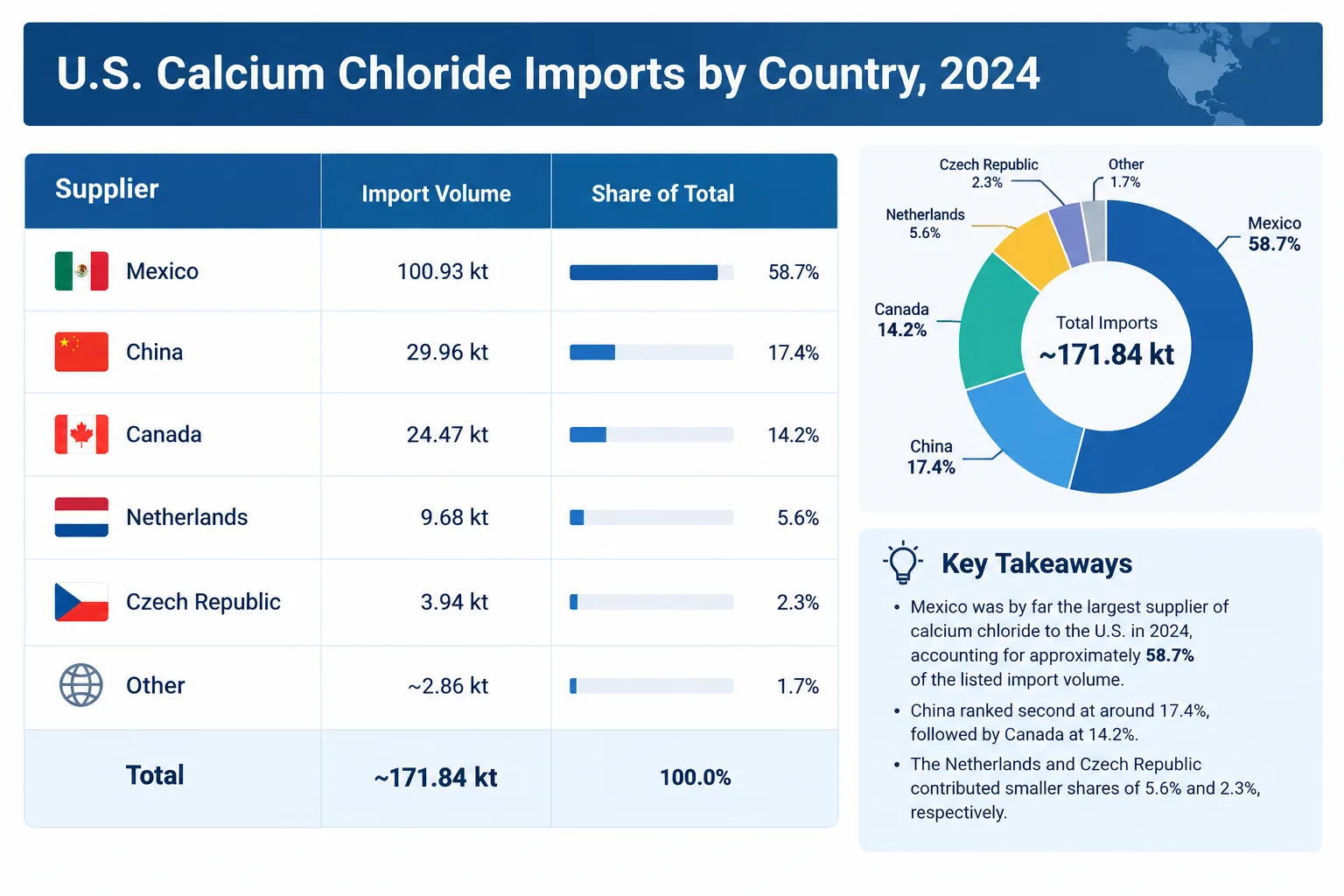
Chinese Calcium Chloride Supply Maintains a Link to the U.S. Import Market
China remains a major global producer and exporter of calcium chloride, with shipments serving markets across Asia, North America and Europe. As of June 2025, Chinese calcium chloride, including flake, granular and dihydrate grades, continued to be available in the U.S. market.
With U.S. domestic supply generally stable, Chinese material remained a supplementary source rather than a primary driver of the country's overall supply-demand balance. Nevertheless, importers continued to assess Chinese offers based on a combination of product pricing, specifications and ocean freight costs, with delivered economics determining the competitiveness of overseas material against domestic supply.
From a global supply-chain perspective, China’s large production base and established export infrastructure provide U.S. buyers with an additional sourcing option. The competitiveness of Chinese material can become more pronounced when regional U.S. supply tightens, freight distances favor imports, or price differentials between domestic and overseas markets widen. These factors can influence import purchasing activity even when the broader U.S. calcium chloride market remains adequately supplied.
U.S.-China Logistics Conditions Influence Import Costs
In June 2025, the U.S.-China trade environment and trans-Pacific shipping market remained subject to ongoing adjustments. Changes in maritime demand, tariff measures and freight rates along the China-U.S. trade route continued to have the potential to affect the landed cost of Chinese calcium chloride in the U.S. market.
For calcium chloride, which has a relatively low unit value and is therefore particularly sensitive to transportation costs, changes in ocean freight can have a material impact on import economics. Lower freight rates from China to the U.S. could improve the competitiveness of imported material, while higher tariffs, port charges or ocean freight costs would increase landed costs for both Chinese suppliers and U.S. buyers.
As a result, U.S. import pricing for Chinese calcium chloride will depend not only on producer offers in China but also on the broader cost structure of international trade. Market participants will continue to monitor tariff developments, trans-Pacific freight rates and other logistics costs alongside Chinese export prices when assessing the competitiveness of imported material.
Domestic Supply and Chinese Exports to Shape Market Developments
Overall, fundamentals in the U.S. calcium chloride market remained broadly stable in June 2025. The moderate increase in prices was supported by logistics costs and relatively resilient industrial demand, while softer construction activity capped further upward momentum. Domestic production continued to underpin the U.S. supply balance, with overseas suppliers, including China, serving primarily as supplementary sources through import channels.
Market participants will continue to monitor U.S. construction and infrastructure activity, domestic producer operating and supply conditions, diesel and transportation costs, as well as Chinese export prices and trans-Pacific freight rates. If U.S. downstream demand remains stable while Chinese export availability and shipping costs remain relatively steady, the domestic market is likely to remain broadly balanced. Regional supply conditions and changes in import-related costs will remain key factors influencing price direction and trade flows.
Sources: U.S. International Trade / World Bank WITS, Eximpedia, U.S. Census Bureau / U.S. International Trade Commission, ChemAnalyst.