
On August 29, 2026, Tata Chemicals North America (TCNA) won the bid for Searles Valley Minerals’ (SVM) North American soda ash customer contracts for approximately $21.16 million in cash during SVM’s Chapter 11 proceedings before a Delaware bankruptcy court. The contracts cover more than 500,000 metric tons of soda ash, with a supply period running from September 2026 through December 2028. They are expected to generate more than $110 million in revenue for TCNA.
Behind this transaction lies a structural shakeup currently underway in the North American soda ash industry. SVM’s exit, TCNA’s acquisition of its contracts, and WE Soda’s integration of Genesis Alkali will further consolidate the North American natural soda ash supply landscape.Meanwhile, China soda ash production capacity continues to expand, increasing export availability and intensifying competition in the global soda ash market.
SVM’s Exit from the Soda Ash Market: Declining Production Capacity and Rising Costs
SVM’s bankruptcy followed years of operational and financial pressure.
The Impact of the 2019 Earthquake. In July 2019, the Ridgecrest earthquake struck SVM’s production facility in Trona, California, damaging surface and underground mining systems, reducing brine quality and limiting brine extraction.Repair costs and lost revenue totaled approximately $50 million. EBITDA fell from approximately $52 million in fiscal 2019 to $2 million in fiscal 2020.
Structural Downturn in the Global Soda Ash Market. After 2019, the global soda ash market entered a phase of oversupply. This was driven by capacity additions in China, weak demand from the construction and glass industries, and rising environmental compliance costs. SVM’s net soda ash sales fell from approximately $223 million in fiscal 2023 to approximately $147 million in fiscal 2026, with net losses of $18 million, $24 million, $27 million, and $71 million for four consecutive years. By early 2026, monthly cash burn exceeded $5 million.
High Energy Costs Added to the Pressure. High energy costs in California added significantly to SVM’s operating pressures. Energy costs accounted for approximately half of the company’s soda ash production expenses, and electricity costs in California were significantly higher than those faced by competitors in other U.S. states and overseas. California State Senator Rosilicie Ochoa Bogh said following the layoffs that high operating costs in California were putting pressure on traditional manufacturing businesses.
In February 2026, SVM halted soda ash production and laid off approximately 240 employees, or about 46% of its workforce,and ceased using the Port of San Diego’s export facilities. On June 15 of the same year, SVM filed for Chapter 11 bankruptcy protection in a U.S. bankruptcy court in Delaware. Following SVM’s exit, its customers had to secure alternative sources of soda ash, creating an opportunity for other North American producers to expand their customer bases.
TCNA Takes Over SVM Contracts and Expands Its Customer Base
The core of this transaction for TCNA was not the purchase of SVM’s production facilities, but rather the acquisition of strategic customer contracts in the bulk soda ash market. These contracts involve orders exceeding 500,000 metric tons, equivalent to a contract acquisition cost of only about $42 per metric ton. The contracts are expected to generate more than $110 million in revenue for TCNA through December 2028, giving the company additional contracted sales volume and strengthening its position in the North American market.
TCNA operates one of North America’s largest soda ash production facilities in Green River, Wyoming, where it mines a trona deposit covering approximately 55 square miles. The company mines more than 4.5 million metric tons ofa ore annually, with estimated recoverable reserves of approximately 600 million metric tons. According to relevant licensing documents from 2025, the Green River facility previously had an approved soda ash production capacity of approximately 2.8 million metric tons per year, and the company has applied to increase this capacity to approximately 3.2 million metric tons per year. At the current mining rate, the deposit could support production for approximately 100 years.As one of the world’s largest soda ash producers, TCNA has the production capacity to fulfil these additional contracts.
North American Soda Ash Supply Becomes More Concentrated
SVM’s exit and TCNA’s takeover are merely a snapshot of the increasing concentration in the North American soda ash industry. An even more significant shift stems from WE Soda’s integration of Genesis Alkali.
In March 2025, WE Soda completed its acquisition of Genesis Alkali for approximately $1.425 billion. Genesis Alkali operates two natural soda ash production facilities in Wyoming, with a combined annual production capacity of approximately 4.35 million metric tons. Following the acquisition, WE Soda’s total production capacity reached approximately 9.5 million metric tons per year, making it the world’s largest soda ash producer. Today, North American natural soda ash production is concentrated among three major producers: WE Soda, including the former Genesis Alkali operations, TCNA and Sisecam Wyoming. Following the shutdown of SVM, its soda ash production capacity of approximately 1 million metric tons per year has effectively exited the competitive market. SVM’s exit has further increased the concentration of North American natural soda ash production among the remaining large producers.
According to USGS data, U.S. soda ash production in 2024 was approximately 12 million metric tons, with the industry’s nominal production capacity at about 13.9 million metric tons per year and domestic consumption ranging from 4 to 5 million metric tons per year. This means that approximately 55% to 60% of U.S. soda ash production is exported, primarily to markets in Asia, Latin America, and the Middle East.
Global soda ash demand growth is projected to slow further to 0.5% in 2026. After growing by 8.5% in 2024, global demand increased by only 1.4% in 2025. The growth rate is projected to slow further to 0.5% in 2026. China’s soda ash exports exceeded 2 million metric tons in 2025 and continue to expand. North American producers therefore face a more concentrated domestic market but continued competition in export markets. Chinese producers, supported by large-scale and cost-competitive production, are becoming an increasingly important source of international supply and influencing global soda ash price trends.
China’s Expanding Soda Ash Capacity Strengthens Its Cost Advantage in Export Markets
China is the world’s largest soda ash producer and consumer, and its expanding capacity has become a major factor influencing global supply and soda ash exports. According to USGS data, China soda ash production in 2024 was approximately 36 million metric tons, representing a year-over-year increase of about 10%—significantly higher than that of other major producing countries. China, the United States, and Turkey together accounted for approximately 81% of global soda ash production. A major natural soda ash project in Inner Mongolia, which began operations in mid-2023, further expanded China’s natural soda ash capacity by approximately 5 million metric tons per.
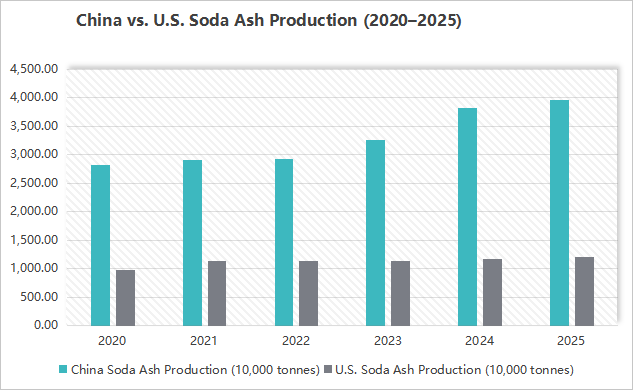
China’s competitive advantage stems not only from the scale of its production capacity but also from its comprehensive chemical industry chain and relatively low overall production costs. By 2025, China soda ash exports had exceeded 2 million metric tons, and Chemical Market Analytics projects that, as domestic supply surplus pressures persist, China’s export volume in 2026 may approach or exceed 3 million metric tons.
Export prices also reflect the price competitiveness of Chinese soda ash suppliers, particularly in the bulk soda ash market. Data shows that China’s soda ash export prices fell from approximately $301 per metric ton FOB in early 2024 to about $187 per metric ton FOB in May 2025. Rising domestic supply and slower demand growth have encouraged Chinese producers to increase exports and ease oversupply in the domestic market.
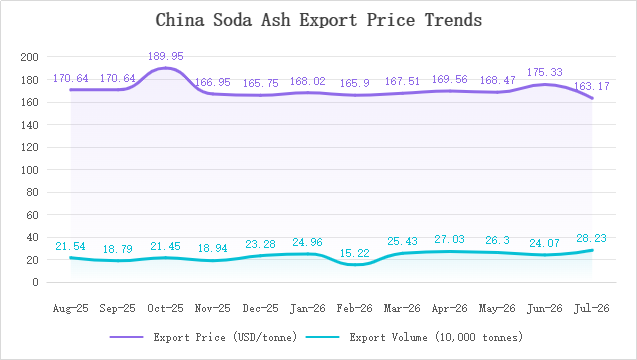
For North American producers, rising Chinese supply means greater competition in global export markets, particularly as buyers continue to evaluate soda ash price, supply reliability, and long-term contracts. U.S. natural soda ash producers retain significant resource and cost advantages, but they also face growing competition from cost-competitive Chinese products in international markets. SVM’s exit reflects the pressure on high-cost production capacity, while China’s expansion of production has further intensified price competition in the global soda ash market.