
Global Soda Ash Consumption Structure in the Flat Glass Industry
Dense soda ash is a key raw material in flat glass, particularly float glass, production. It lowers the melting temperature of the batch and helps stabilize the silicate structure. Producing one metric ton of flat glass requires approximately 0.2 metric tons of dense soda ash. Soda ash accounts for around 54% of raw material costs in flat glass manufacturing, making it the largest single raw material cost component.
As a result, changes in flat glass production have a direct impact on soda ash consumption. Regional differences in construction activity, glass production capacity, operating rates and furnace utilization are therefore important indicators for assessing the outlook for the global soda ash market.
Current Regional Patterns of Soda Ash Consumption in the Global Flat Glass Industry
Asia-Pacific is the world's largest flat glass production and soda ash consumption region, with China, India, and Southeast Asia forming the three major markets.
China: Weakening Glass Production Weighs on Soda Ash Demand
China's flat glass industry is undergoing a sustained production contraction, putting downward pressure on dense soda ash demand from the glass sector.
In May 2026, the float glass industry's operating rate was 69.73%, while daily output was approximately 145,100 metric tons, down 7.23% year over year. Total inventories at sampled float glass producers reached 76.411 million heavy boxes, up 12.23% year over year and the highest level for the same period. Flat glass production totaled 75.48 million weight boxes in May, down 6.3% year over year. Production for January-May reached 370.41 million weight boxes.
From the capacity side, From January to May 2026, China's daily melting capacity for operating float glass lines fell by 6,340 metric tons to 145,105 metric tons. Daily melting capacity for operating photovoltaic glass lines declined by 10,325 metric tons to 10,325 metric tons.
By mid-May, combined operating melting capacity for float glass and photovoltaic glass stood at 228,995 metric tons/day, approximately 60,000 metric tons/day below the peak recorded in July 2024. Based on the consumption rate cited above, this represents a reduction of approximately 12,000 metric tons/day in soda ash demand.
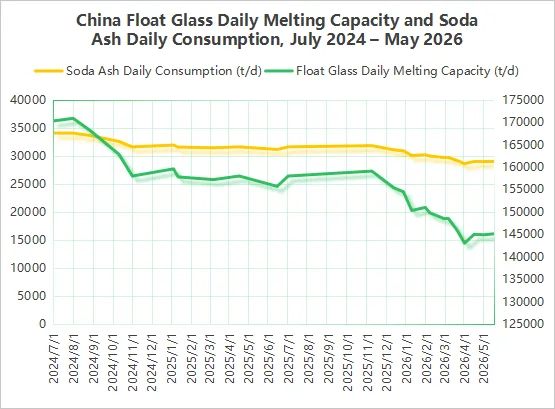
China's weakening demand for float glass is primarily rooted in the continued downturn in the property sector.From January to April 2026, completed housing floor area totaled 1.1886 billion square meters, down 24.0% year over year.
Housing completions are a direct source of current demand for float glass. Assuming the property sector accounts for 80% of total glass demand, the decline in housing completions alone would reduce overall glass demand by approximately 18.7%.
With glass inventories remaining high and market expectations weak, soda ash demand from China's float glass sector could continue to decline through 2026.
South and Southeast Asia: Emerging Sources of Demand Growth
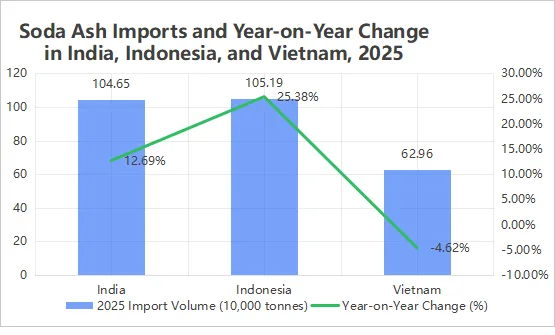
India, Indonesia, Vietnam and other markets across South and Southeast Asia continue to urbanize, while domestic flat glass capacity is expanding. These markets are among the few regions where soda ash demand from the flat glass sector is still expected to increase.
In India, continued urbanization and the expansion of photovoltaic glass production are supporting soda ash consumption. The country's float glass market is expected to expand at a compound annual growth rate of 25.14% from 2026 to 2032.
However, India's domestic soda ash capacity remains insufficient to meet demand, leaving the market highly dependent on imports. In March 2026, India launched a safeguard investigation into soda ash imports. At the same time, zero-tariff imports were implemented from April through June, creating a short-term opportunity for Chinese suppliers.
Indonesia plans to add 30 million housing units, which is expected to support further expansion of domestic glass production capacity. Indonesia imported 144,700 metric tons of soda ash in February 2026, up 103.34% year over year.
Vietnam's soda ash imports reached 89,700 metric tons in April 2026, up 94.85% year over year. Under the ASEAN-China Free Trade Area (ACFTA), Chinese imports are subject to zero tariffs.
These developments point to a growing role for South and Southeast Asia in the global soda ash market, particularly as domestic glass manufacturing capacity expands and local soda ash supply remains insufficient in some markets.
Europe and North America
In Europe, aging glass furnaces are being taken offline at an accelerating pace, resulting in a year-on-year decline in soda ash consumption. European soda ash production relies mainly on the ammonia-soda process and is highly exposed to natural gas costs. Persistently high energy costs have placed additional pressure on domestic producers.
European flat glass production declined 7.27% year over year during January-February 2026, while the industry remained broadly loss-making. Coal-gas-fired float glass production recorded losses of approximately RMB 36/metric ton, while natural-gas-fired production recorded losses of approximately RMB 83/metric ton. Continued losses are encouraging more production lines to undergo cold repairs.European soda ash demand growth has slowed to approximately 0.9%.
Meanwhile, the EU Carbon Border Adjustment Mechanism (CBAM) entered its definitive phase on January 1, 2026. The policy introduces carbon-related costs for imported soda ash. Carbon costs for European glass producers are expected to increase by approximately €28-35/metric ton of product.
This policy and cost environment is adding pressure to the European glass industry and may accelerate furnace cold repairs and capacity exits, further reducing regional soda ash consumption.
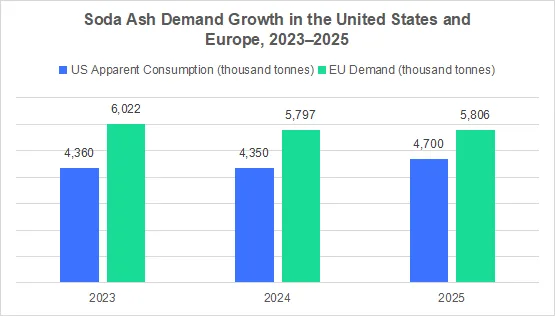
North America presents a different picture. Demand remains relatively stable, although growth is limited. The North American flat glass market was valued at $74.8 billion in 2025 and is expected to reach $78.09 billion in 2026, representing a compound annual growth rate of 4.4%.
In the United States, nearly 57% of soda ash consumption is related to glass manufacturing. Construction and packaging are key downstream markets. Repair and renovation activity in construction, together with automotive glass demand, provides some support for the market. However, overall growth remains modest, with North American soda ash demand growth estimated at only 1.8%.
The United States also benefits from abundant natural soda ash resources. Trona mines in Wyoming are operating at full capacity, keeping supply ample and prices largely range-bound.
Three Key Variables That Will Shape Soda Ash Consumption Over the Next 2-3 Years
Property, Construction and Infrastructure Demand
Approximately 70% of flat glass is used in construction, making construction activity and property completion cycles important drivers of soda ash consumption.
A recovery in construction activity would support higher glass plant operating rates and, in turn, increase soda ash procurement. Conversely, persistently low operating rates and additional furnace cold repairs would continue to reduce overall soda ash demand.
The global construction market is increasingly fragmented by region. Mature economies offer limited incremental demand, while emerging markets are expected to remain the main sources of growth.
Continued Growth in Glass Cullet Use
The growing use of recycled glass cullet is another structural factor affecting soda ash demand.Each kilogram of glass cullet can save the equivalent of approximately 250 grams of soda ash. Increasing the proportion of cullet in the batch by 10% can reduce energy consumption by 2%-3% and extend furnace service life by 15%-20%. Recycling one metric ton of waste glass can save approximately 0.2 metric tons of soda ash and 0.7 metric tons of quartz sand, reducing the cost of glass products by around 20%.
The industry has already begun implementing these practices. AGC Glass Europe and German company Reiling have established an industrial-scale closed-loop recycling process for automotive windshields, with the cullet content reaching 88%, compared with approximately 40% in conventional processes.
This trend has an important implication for the global soda ash market: glass production volumes alone may increasingly overstate underlying soda ash demand. Future demand assessments should therefore consider not only glass production and capacity, but also changes in glass cullet utilization rates. In other words, even if flat glass production remains stable, higher cullet use could reduce the amount of fresh soda ash required per metric ton of glass.
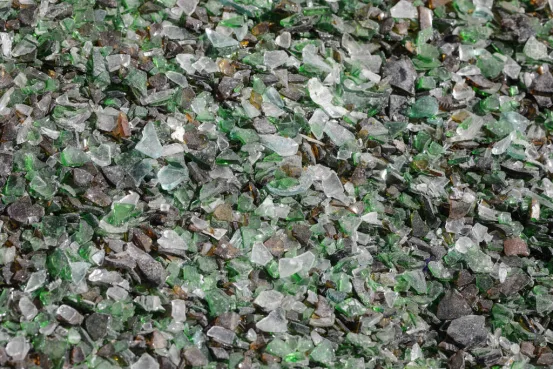
Figure 1. Glass cullet at a recycling facility. Source: Public domain / CC0.
The Pace of Glass Capacity Rationalization
The pace of glass furnace capacity rationalization will also influence future soda ash demand.Glass furnaces have long cold-repair cycles and high restart costs. Since November 2025, cold repairs have accelerated across the industry.
As of March 20, 2026, the number of operating production lines had fallen to 207, while daily melting capacity had declined to 144,900 metric tons. Both indicators were at their lowest levels in a decade.By the end of March, daily melting capacity had fallen further to approximately 145,000 metric tons, a historical low.From November 2025 through January 2026, a cumulative 12,070 metric tons/day of capacity underwent cold repairs, significantly faster than during the same period in previous years. The industry entered March with a more fragmented operating pattern. Some production lines continued to undergo cold repairs, while others restarted, reflecting differences in production costs and regional supply-demand conditions.
The pace of capacity exits matters because the effect on soda ash demand can be either temporary or permanent.If prolonged losses force inefficient glass capacity to permanently exit the market, the associated soda ash demand will also disappear permanently. If profitability subsequently improves and furnaces restart, soda ash procurement could recover temporarily.
This relatively rigid and slow-to-adjust demand structure can create temporary supply-demand mismatches in the soda ash market, making changes in downstream glass production an important factor in price formation.
Outlook for Global Soda Ash Consumption
As of May 2026, the global flat glass industry is showing clear regional divergence in soda ash consumption, while soda ash consumption per unit of glass production is gradually declining.
Global soda ash consumption is expected to reach approximately 73 million metric tons in 2026, with Asia-Pacific providing the main source of incremental demand. Demand remains relatively weak in mature markets such as China, while South and Southeast Asia are expected to contribute moderate growth.The increasing use of recycled glass represents a longer-term structural factor that could reduce dense soda ash consumption.
At the same time, weakening property-sector demand for float glass in China and overcapacity in photovoltaic glass are limiting growth in the major Asian market. As a result, demand for dense soda ash may remain broadly stable or decline slightly. Over the next five years, demand growth for light soda ash is expected to outpace that for dense soda ash.
In the short term, soda ash demand will continue to be closely linked to glass plant operating rates and construction activity. Over the longer term, higher glass cullet utilization will weaken the traditional linear relationship between glass production and soda ash consumption.
For soda ash suppliers and buyers, this means that monitoring glass production capacity alone is no longer sufficient. Key indicators should also include glass plant operating rates, furnace cold repairs, furnace restarts, glass cullet utilization, regional construction activity and downstream demand. These factors will provide a more complete picture of the direction of soda ash demand and the potential changes in regional procurement requirements.