
In November 2024, the U.S. soda ash market remained under pressure, with prices continuing to trend lower amid ample availability and subdued downstream demand. Procurement activity from key end-use sectors, including glass manufacturing and construction, showed limited improvement, leaving the market increasingly oversupplied. Meanwhile, elevated financing costs and persistent macroeconomic uncertainty continued to weigh on activity in the U.S. manufacturing and real estate sectors, limiting potential growth in soda ash consumption. By the end of the month, market sources continued to point to ample supply and weak end-user demand as the key factors weighing on U.S. soda ash prices.
Ample Supply Puts Downward Pressure on U.S. Soda Ash Prices
In November, supply-side pressure remained the primary factor weighing on the U.S. soda ash market. Availability was relatively ample, while near-term consumption growth remained limited, further widening the gap between production and downstream demand. A late-November market assessment by ChemAnalyst indicated that U.S. soda ash prices continued to decline, with ample supply and weak demand from major end-use sectors cited as key factors behind the downward price trend.
The United States remains a major global producer of natural soda ash, with production largely based on trona resources in Wyoming’s Green River Basin. The cost advantage of natural soda ash over synthetic production provides the U.S. market with a relatively competitive and stable production base, supporting both domestic supply and export availability. The U.S. Geological Survey (USGS) classifies soda ash as an important industrial mineral and regularly reports data on U.S. production, trade and inventories.
With demand growth remaining limited in November, sustained production and ample availability increased the volume of soda ash offered into the market, leaving suppliers with limited scope to raise prices. Ample availability also gave downstream buyers greater flexibility in their procurement strategies. Buyers largely remained cautious, with purchasing activity focused on covering near-term requirements rather than building inventories.
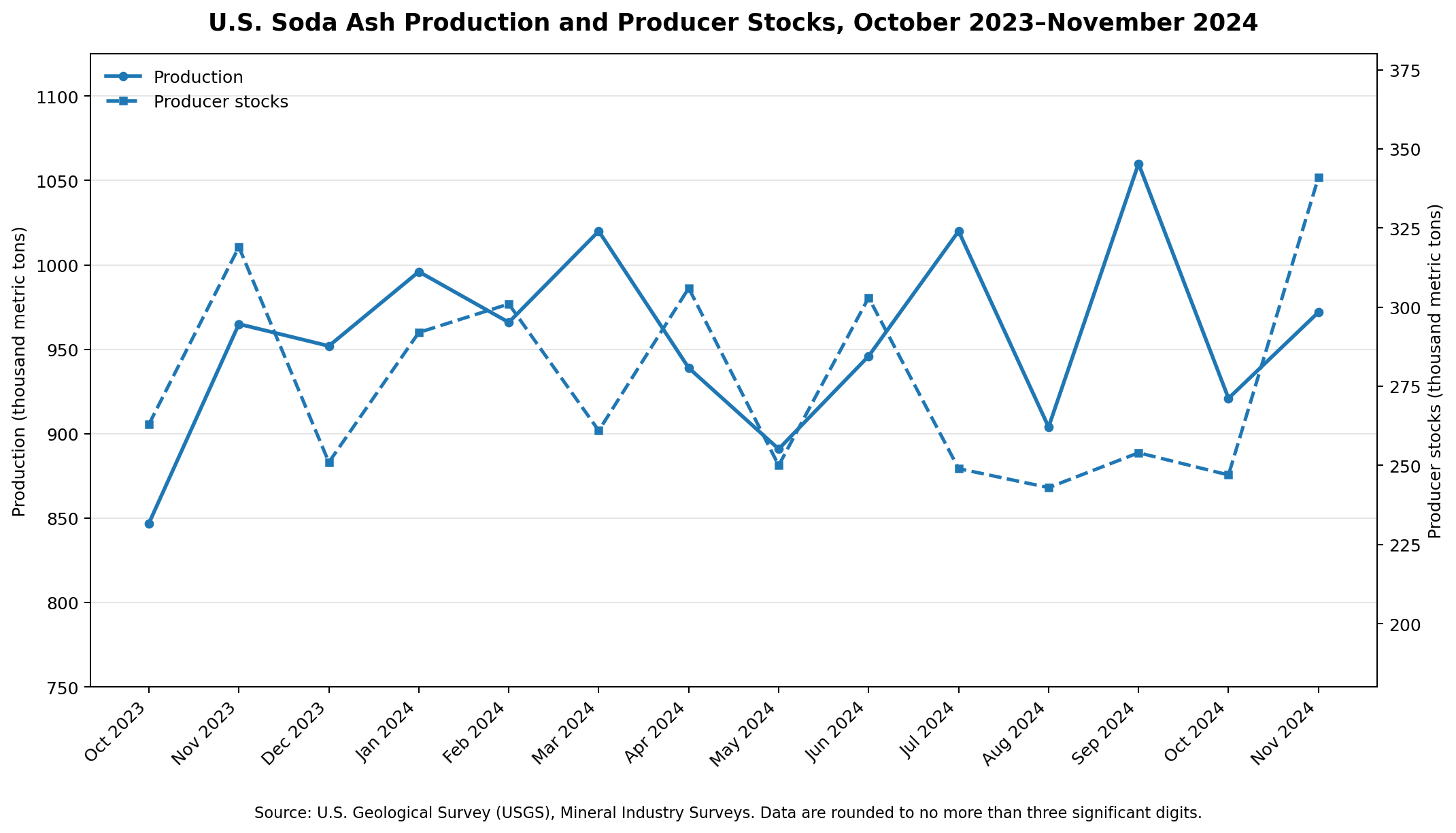
As a result, the decline in U.S. soda ash prices in November appeared to reflect a broader imbalance between relatively ample supply and insufficient growth in consumption, rather than the impact of any single supply-side event.
Weak Glass and Construction Demand Weighs on Consumption
Demand-side fundamentals also remained a key source of pressure on the U.S. soda ash market. Soda ash is a major raw material for glass production, including flat glass and container glass, making demand from downstream sectors such as construction and automotive manufacturing an important driver of consumption. The U.S. Geological Survey (USGS) identifies automotive manufacturing and construction-related flat glass production among the end uses for soda ash and regularly reports U.S. soda ash production as part of its industrial minerals data.
In November 2024, activity in the U.S. construction sector had yet to recover sufficiently to provide a meaningful boost to glass demand. Elevated interest rates and persistent housing affordability constraints continued to weigh on residential and real estate activity, while infrastructure spending progressed at a relatively subdued pace. A late-November assessment by ChemAnalyst pointed to weak consumption in the U.S. construction and glass sectors, along with slower housing starts and a reduced pace of infrastructure activity, as factors limiting soda ash demand.
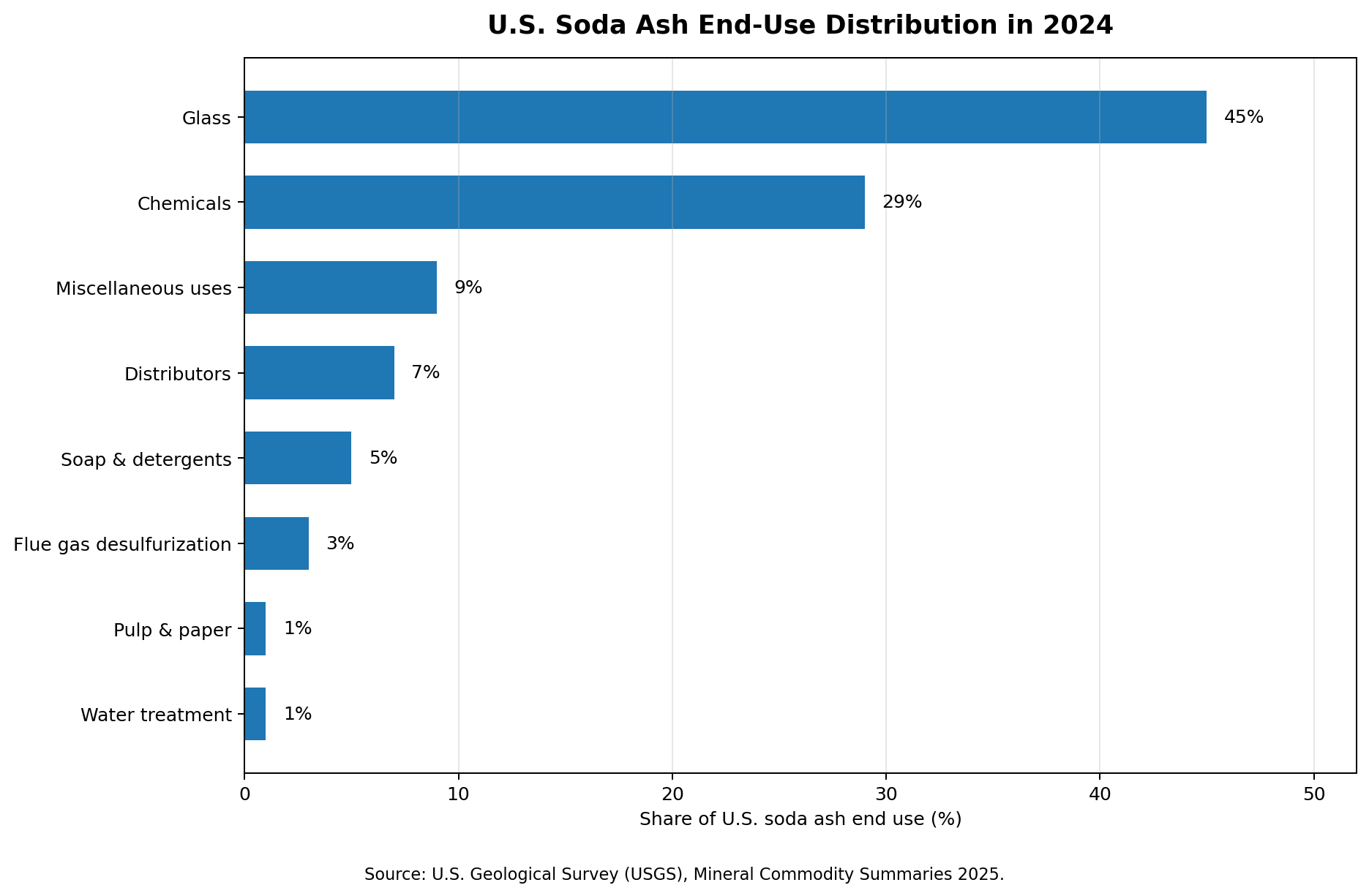
Compared with October, there was little evidence of a meaningful improvement in demand momentum in November. Downstream buyers largely continued to base purchases on current production requirements and confirmed order volumes, rather than building inventory ahead of anticipated demand. With supply remaining ample, this cautious procurement behavior added to the downward pressure on soda ash prices.
Overall, demand-side fundamentals remained insufficient to absorb the available supply, leaving the U.S. soda ash market under continued pressure in November.
Domestic Production, Stocks and Exports Remain Key Market Factors
In addition to domestic supply and demand fundamentals, inventory levels and export activity remained important factors influencing the U.S. soda ash market. The cost competitiveness of natural soda ash production allows U.S. producers to supply both the domestic market and overseas customers, making export demand an important outlet for domestic production. The U.S. Geological Survey (USGS) tracks U.S. soda ash production, trade, inventories and consumption, providing indicators of the broader market balance.
With domestic demand remaining subdued in November, export demand became increasingly important in determining the market balance. If domestic production and availability remain elevated while export demand is insufficient to absorb surplus volumes, inventory levels could remain under pressure and limit the potential for a sustained price recovery. At the same time, movements in international soda ash prices could influence U.S. producers’ export economics, destination markets and sales strategies.
Market participants were also closely monitoring potential changes in U.S. trade policy following the presidential election, particularly the tariff measures that could be introduced by the incoming Trump administration. Late-November market assessments suggested that the prospect of changes to trade policy had increased uncertainty around North American supply chains and construction material costs, while adding another layer of uncertainty to the outlook for the U.S. soda ash market.
Overall, the combination of subdued domestic demand, the importance of export outlets and uncertainty surrounding future trade policy continued to shape market sentiment in November.
U.S. Soda Ash Market Outlook Remains Under Pressure
In the near term, the U.S. soda ash market is likely to remain under pressure from ample supply and subdued downstream demand. Unless there is a meaningful recovery in major consuming sectors such as glass and construction, relatively stable domestic production and high availability are likely to limit the upside potential for prices.
Market participants are expected to closely monitor domestic production, inventory movements, glass-sector procurement activity and export demand. A gradual recovery in downstream consumption, combined with production adjustments, could tighten the supply-demand balance and provide support for price stabilization. Conversely, if availability remains ample and end-user purchasing activity shows limited improvement, soda ash prices are likely to remain on a weak footing.
Overall, the U.S. soda ash market in November 2024 was characterized by ample supply, subdued downstream demand and continued downward price pressure. Weak activity in the glass and construction sectors constrained consumption growth, while the U.S.’s competitive natural soda ash production base maintained a high degree of supply availability. Going forward, the near-term price outlook will depend primarily on the pace of supply adjustments, the strength of the downstream demand recovery and developments in export markets.
Sources: U.S. Geological Survey (USGS); ChemAnalyst