
In January 2025, the U.S. sodium nitrite market remained broadly stable, with market participants focused primarily on U.S. import trade policy, shifts in supply sources and downstream demand.
On Jan 23, the U.S. International Trade Commission (USITC) issued its five-year (sunset), review determination on sodium nitrite imports from China and Germany. The commission determined that revoking the existing trade remedy measures would be likely to lead to the continuation or recurrence of material injury to the U.S. domestic industry within a reasonably foreseeable period.
As a result, the existing antidumping and countervailing duty measures on Chinese sodium nitrite, along with the antidumping duty order on German sodium nitrite, will remain in place. The continuation of these measures is expected to maintain the existing trade framework for Chinese and German sodium nitrite imports and remain an important factor shaping the U.S. market's supply landscape.
USITC Maintains Trade Measures on Sodium Nitrite from China and Germany
The USITC’s Jan 23 review determination indicated that revoking the existing trade remedy measures could result in imports of sodium nitrite from China and Germany continuing to cause, or again causing, material injury to the U.S. domestic industry. The review covered the trade remedy measures previously imposed by the United States on sodium nitrite imports from the two countries.
The determination suggests that the trade policy environment for the U.S. sodium nitrite import market remained largely unchanged in early 2025. Chinese suppliers continued to face antidumping and countervailing duty measures, while German suppliers remained subject to antidumping duties. As these measures influence import costs and trading terms, U.S. trade policy remained an important factor shaping the domestic market’s supply structure.
Import Restrictions Continue to Shape U.S. Supply Dynamics
The trade measures do not necessarily indicate a significant supply shortage in the U.S. sodium nitrite market, but they can affect the competitiveness of different supply sources and the composition of imported volumes. For U.S. buyers, the balance between domestic production, established import channels and alternative overseas suppliers will remain an important factor determining overall market availability.
With some traditional supply sources subject to trade restrictions, U.S. importers may place greater emphasis on the availability, price competitiveness and logistics conditions of alternative suppliers. As a result, the supply landscape for sodium nitrite in the United States will depend not only on domestic production capacity but also on shifts in international trade flows and the availability of alternative import sources.
India Emerges as a Major Source of U.S. Nitrites Imports
Full-year 2024 trade data indicate that U.S. sodium nitrite imports were highly concentrated by origin. According to World Bank WITS and UN Comtrade data, U.S. imports under HS code 2834.10, covering “Nitrites,” totaled approximately 11,940 metric tons in 2024. India accounted for the largest share at approximately 8,163 metric tons, or 68.4% of total imports, followed by China at approximately 3,690 metric tons, or 30.9%. Combined, imports from India and China accounted for more than 99% of total U.S. imports in 2024, highlighting the highly concentrated nature of the U.S. import supply base.
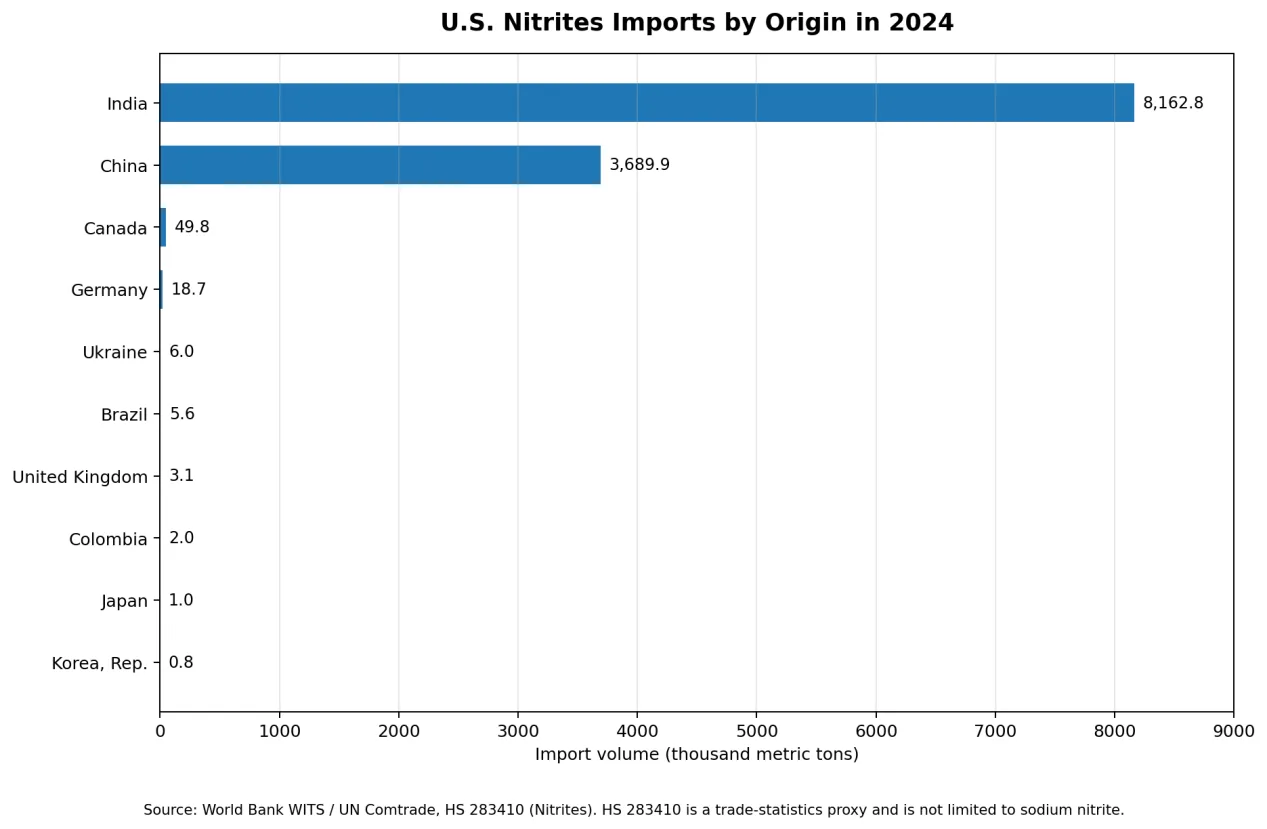
By comparison, Germany’s exports of products under the same HS code to the United States totaled only approximately 18.7 metric tons in 2024. The trade data suggest that, amid the continued application of U.S. trade remedy measures on imports from China and Germany, India had emerged as one of the key supply sources for the U.S. nitrite import market.
It should be noted that HS code 2834.10 covers “Nitrites” as a broader product category and is not specific to sodium nitrite. Accordingly, the above figures should be treated as a statistical reference for international trade flows of nitrites into the United States rather than as a direct measure of pure sodium nitrite import volumes. A relevant USITC report also notes that the customs classification includes certain products that fall outside the scope of the underlying investigation.
Food, Chemicals and Industrial Applications Support Downstream Demand
Downstream applications for sodium nitrite in the United States are relatively diverse, providing a broad base of end-use demand. According to USITC data, sodium nitrite is used in food processing and the curing and preservation of meat products, as well as in a range of industrial applications, including chemical and dye production, metal surface treatment, corrosion inhibition, synthetic rubber manufacturing, heat-transfer salts and wastewater treatment.
Food processing and meat curing remain important application areas for sodium nitrite, while its broad range of industrial uses helps reduce the market’s exposure to demand fluctuations in any single downstream sector. As a result, although procurement patterns can vary across end-use industries, the diversity of applications provides underlying support for U.S. sodium nitrite demand and contributes to a relatively stable demand base.
U.S. Sodium Nitrite Market Outlook Remains Closely Linked to Trade Flows
In January 2025, the fundamentals of the U.S. sodium nitrite market remained broadly stable, although trade policy continued to play an important role in shaping the market’s supply structure. With existing trade remedy measures on imports from China and Germany remaining in effect, U.S. buyers are likely to maintain interest in alternative supply sources. In this context, the role of suppliers such as India in the U.S. import market warrants continued monitoring.
Market participants are expected to focus on domestic production, import sources, developments in U.S. trade policy and procurement activity across key downstream sectors, including food processing, chemicals and other industrial applications. Significant changes in international supply flows or downstream purchasing patterns could alter the supply-demand balance and influence price performance in the U.S. sodium nitrite market.
Overall, the U.S. sodium nitrite market did not show a significant supply-demand imbalance in January 2025, with market dynamics driven primarily by trade policy and the composition of import supply. As existing trade measures remain in place, the competitive landscape of the U.S. market will continue to depend on international trade flows, the availability and competitiveness of alternative supply sources, and trends in downstream demand.
Sources: U.S. International Trade Commission (USITC); World Bank WITS / UN Comtrade; U.S. International Trade Commission (USITC)