
Following disruptions to naphtha supplies, some Asian ethylene producers faced raw material shortages and rapidly rising costs. South Korea’s ethylene plant operating rate reportedly fell from 80% in February to 62% in April, while six of Japan’s 12 ethylene producers announced production cuts and several companies declared force majeure.
During its first-quarter 2026 earnings call, U.S.-based Olin said that several Asian vinyl producers had declared force majeure because of limited access to feedstocks and rapidly rising costs. The resulting disruption constrained chlor-alkali production and reduced the availability of co-produced caustic soda. Olin also noted that China had been less affected because of its significant coal-based vinyls production base.
This highlights an important feature of the global caustic soda supply chain: supply stability depends not only on production capacity, but also on the underlying production route.
China Has Built a Caustic Soda Supply Base of More Than 50 Million Metric Tons per Year
According to data from the China Chlor-Alkali Industry Association, China had approximately 174 caustic soda producers at the end of 2025, with total capacity of 51.51 million metric tons per year. Annual output was approximately 46.53 million metric tons, while the industry operating rate was around 90%.
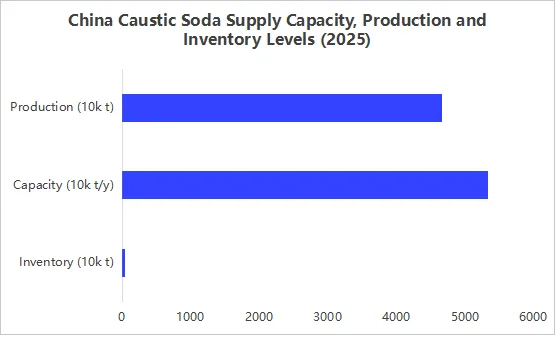
As of February 2026, China’s total caustic soda capacity had reached approximately 51.74 million metric tons per year. There were 157 sampled enterprises with annual capacities of 100,000 metric tons or more, representing about 97% of national capacity. The number of production enterprises had reached 177.
Major producers include Zhongtai Chemical, Junzheng Group, and Xinjiang Tianye. During the week of February 20–26, 2026, the capacity utilization rate of sampled Chinese caustic soda producers with annual capacities of at least 100,000 metric tons was 84.9%.
China’s caustic soda production is distributed across North China, East China, Northwest China, Southwest China, and Central China. Large chlor-alkali producers also tend to operate integrated production chains covering salt, electricity, caustic soda, chlorine, and PVC.
This broad geographic and industrial base means that maintenance or a temporary production cut at a single plant is more likely to affect regional availability than to cause a nationwide supply disruption.
For overseas buyers, the significance of this scale is straightforward: China caustic soda supply is supported by a large number of producers across multiple regions rather than by a small number of individual plants.
Table1. Selected Chinese Caustic Soda Producers
Carbide Process Dominance: China’s Chlor-Alkali Industry Reduces Reliance on Naphtha and Ethylene
This is one of the key structural differences between China and some Northeast Asian markets, including Japan and South Korea.
China’s PVC industry has long been dominated by the calcium carbide process, while the ethylene process serves as a secondary route. China’s total PVC capacity is currently close to 30 million metric tons per year, with the calcium carbide process accounting for approximately 72% and the ethylene process approximately 28%.
The calcium carbide-based PVC chain is:
Coal, limestone, and other resources → Calcium carbide → Acetylene → VCM → PVC
The ethylene-based route is primarily:
Naphtha → Ethylene → EDC/VCM → PVC
The key difference between the two routes is the source of ethylene.
When geopolitical tensions in the Middle East restrict naphtha supplies and push up crude oil and ethylene costs, production systems that rely more heavily on ethylene-based feedstocks can face greater exposure to upstream raw material disruptions.
By contrast, the calcium carbide process relies primarily on coal, limestone, and electricity to produce PVC through the calcium carbide and acetylene route. This results in lower direct dependence on naphtha and externally sourced ethylene.
The difference does not mean that China’s chlor-alkali industry is insulated from energy costs. Electricity and coal prices remain important production-cost variables. However, the different feedstock structures can reduce the direct transmission of a naphtha-to-ethylene supply shock into parts of China’s chlor-alkali system.
ICIS has also highlighted the large role of the carbide route in China’s PVC production and its relationship with the chlor-alkali value chain.
For the global caustic soda supply chain, this production-route difference is therefore an important factor to monitor during periods of severe energy and raw material volatility.
Ample Inventories and Port Advantages Support China’s Rapid Response to Overseas Caustic Soda Demand
In 2026, China’s caustic soda market has maintained relatively high operating rates and substantial inventories.
As of the week ending April 9, factory inventories at sampled Chinese enterprises with fixed liquid caustic soda production capacity of 200,000 metric tons or more stood at 541,100 metric tons on a wet-ton basis, up 14.06% year over year.
This inventory provides a buffer for the domestic market. However, it should not be interpreted as equivalent to immediately exportable solid caustic soda inventory. For an overseas order, actual availability also depends on production schedules, product form, packaging capacity, port operations, and vessel schedules.
Following the escalation of the Middle East conflict in March 2026, Chinese exporters reportedly received increased overseas inquiries. According to the market data used in this article, caustic soda exports in March increased 53% year over year. Shandong-based producers had largely secured their April export orders by the end of March, with new demand emerging from Southeast Asia in addition to established destinations such as Indonesia and Australia.
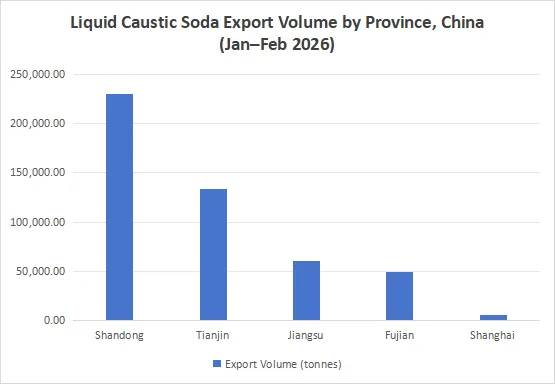
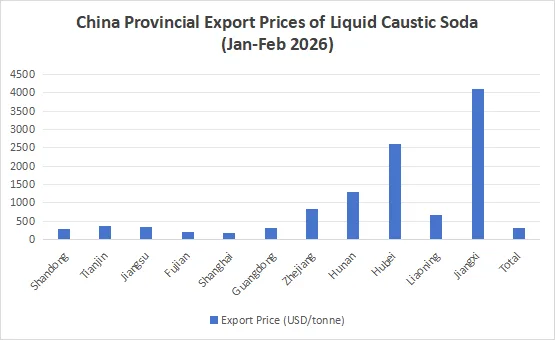
On March 6, 2026, the Jiangyin Port Area of Fuzhou Port completed a single export shipment of 53,000 metric tons of sodium hydroxide solution bound directly for Gladstone, Australia. The shipment set a record for the largest single export shipment by weight in Fujian Province.
Large-volume port loading capability is an important part of the logistics infrastructure supporting China’s international caustic soda supply.
Rising Shipping Risks Are Increasing Interest in Solid Caustic Soda
As shipping risks increase, the product mix of China’s caustic soda exports is also becoming more flexible.
From January to February 2026, China’s cumulative solid caustic soda exports reached 145,800 metric tons, up 107.99% year over year, while liquid caustic soda exports totaled 480,500 metric tons, down 19.47%.
Solid caustic soda, including flakes and pearls, generally offers greater flexibility in international transportation because it can be shipped in suitable containerized or dry-bulk configurations. By contrast, liquid caustic soda typically requires dedicated chemical tankers and appropriate storage and handling infrastructure.
This difference becomes particularly relevant when tanker availability, freight costs, or port logistics become more constrained.
However, the increase in solid caustic soda exports should not automatically be interpreted as proof that all international buyers have shifted from liquid to solid caustic soda. Export growth can also reflect changes in regional demand, arbitrage opportunities, freight economics, inventory strategies, and supplier availability.
For overseas buyers, the practical advantage of solid caustic soda is its logistical flexibility. Flakes and granules can be considered as an alternative supply format when liquid caustic soda transportation becomes less economical or less accessible.
Table 2. Liquid vs. Solid Caustic Soda: Logistics Comparison
Conclusion
China’s ability to maintain a relatively stable caustic soda supply during the 2026 global supply disruption is supported by structural factors rather than short-term emergency measures.
A production base exceeding 50 million metric tons per year and operating rates generally above 85% provide substantial supply capacity. China’s PVC industry is also predominantly based on the calcium carbide process, reducing the direct exposure of parts of its chlor-alkali value chain to naphtha and externally sourced ethylene. At the same time, production across multiple regions and relatively high inventories provide additional supply buffers.
China’s coastal production and logistics network further supports international trade. Major export regions such as Shandong, Tianjin, and Jiangsu provide access to ports, while the availability of both liquid and solid caustic soda gives exporters greater flexibility in responding to different transportation conditions.
For global buyers evaluating alternative sources of caustic soda, the key takeaway is not simply China’s large production capacity. Buyers should also assess a supplier’s current available volume, production route, inventory position, maintenance schedule, solid caustic soda availability, packaging capacity, loading port, and vessel schedule.
These factors provide a more practical basis for evaluating the reliability of a specific Chinese supplier within the broader China caustic soda supply chain.