
In late February 2026, military actions involving the United States, Israel, and Iran severely disrupted shipping activity in the Strait of Hormuz. As a vital shipping route connecting the Persian Gulf and the Indian Ocean, the Strait of Hormuz handles approximately 31% of global seaborne crude oil trade and a significant share of global naphtha shipments.
Following the blockage of the strait, some shipowners adjusted their routes and raised their risk assessments, leading to a significant increase in shipping costs. This, in turn, further drove up spot prices, causing the global caustic soda market to undergo a rapid adjustment in trade flows and cost structures. Among these factors, rising transportation costs for caustic soda exports from the U.S. Gulf of Mexico to Latin American markets, as well as changes in Asian supply chains, have become the primary focus of the current market.
Freight Rates Surge 50% in One Week, Raising U.S. Caustic Soda Export Costs to Brazil
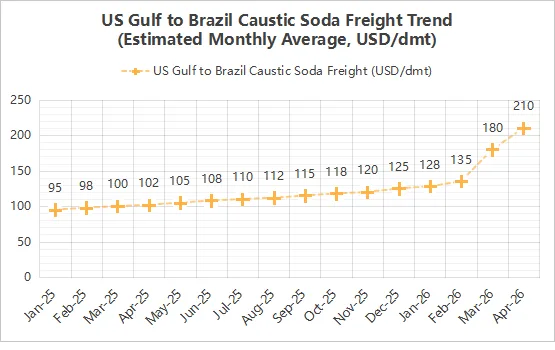
According to a March 3 report by Argus Media, freight rates for U.S. Gulf Coast caustic soda exports have increased sharply following the escalation of tensions in the Middle East, with rates on some routes increasing by approximately 50% compared to previous levels. Specifically, freight rates to Brazil climbed to $180 /dmt, representing a 28–38% increase from estimates at the end of February. Freight rates on transatlantic routes rose by 37%. As the market continued to evolve,
by mid-April, spot freight rates for caustic soda from the U.S. to Brazil temporarily reached $210/dmt, 16% higher than pre-conflict levels. For Brazilian pulp and paper companies that rely on U.S. supplies, this signifies a structural increase in raw material procurement costs.
Red Sea and Strait of Hormuz Risks Extend Global Caustic Soda Supply Chains
In addition to risks in the Strait of Hormuz, shipping safety concerns in the Red Sea continue to impact global chemical transportation. To mitigate these risks, some liquid caustic soda tankers have been forced to take a detour around the Cape of Good Hope, increasing the voyage distance by approximately 4,000 nautical miles and extending transit time by about 10 days. Freight rates have risen by 30%–50%, and when combined with war risk insurance surcharges, this has driven up the CIF costs for all cross-regional caustic soda shipments. Shipments of caustic soda from Asia and Europe to Europe and Africa have all been affected. The transport of liquid caustic soda requires specialized stainless-steel chemical tankers, resulting in limited flexibility in shipping capacity. Following shipping disruptions, vessel availability has tightened, delivery times have extended, and the risk of long-term contract delays has increased.
Compared to liquid caustic soda,caustic soda flakes and caustic soda pearls are easier to store and can be transported via standard containers or as bulk cargo, offering greater supply flexibility during periods of global shipping uncertainty. Consequently, shipping risks may further prompt international buyers to increase their procurement of solid caustic soda.
Ethylene Supply Disruptions Reshape Asia’s Chlor-Alkali Industry Balance
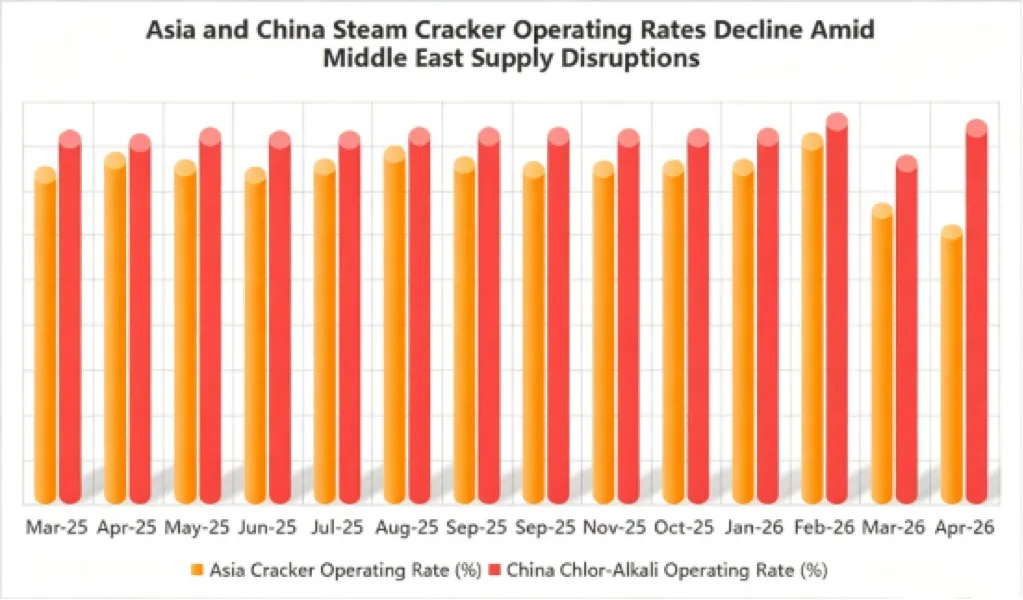
The main pathway through which the Middle East conflict affects the caustic soda market is through upstream feedstock disruptions. The Middle East accounts for 44% of global naphtha exports, with nearly all of it supplied to Asia. Following the closure of the Strait of Hormuz, the operating rate of Asian cracking units plummeted from 83% in February to 62% in April. Approximately 6% to 9% of global olefin production capacity has been shut down, with several Asian olefin producers declaring force majeure.
The ethylene shortage has directly forced overseas integrated chlor-alkali plants using the ethylene process to reduce operating loads. Chlor-alkali plant operating rates in Northeast Asia (Japan, South Korea, and Taiwan, China) have fallen to approximately 60–70%; several vinyl producers have declared force majeure, and a few companies in Southeast Asia have followed suit. During an earnings call, the CEO of Olin Corporation warned that the large-scale production cuts at Asian ethylene plants have triggered a chain reaction of contraction across the olefins and chlor-alkali supply chains, with the global caustic soda market facing continued supply tightness and a strong upward shift in price levels.
China’s chlor-alkali operating rates have remained relatively high at 83–84% because approximately 70% of China’s ethylene capacity is coal-based, making it relatively less affected by disruptions in naphtha supplies. This difference has allowed China’s caustic soda production to remain relatively stable amid the global supply contraction cycle.
China’s Caustic Soda Export Surge Shifts the Global Caustic Soda Trade Center Eastward
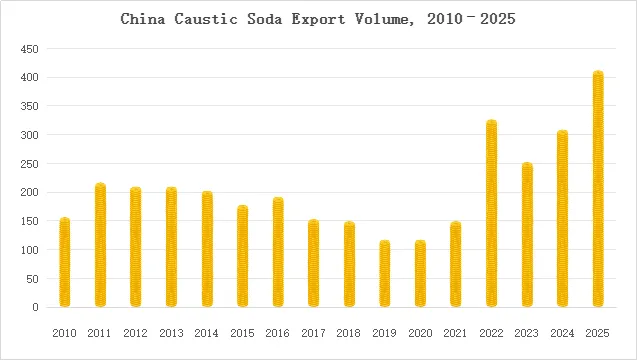
In recent years, China’s chlor-alkali industry has continued to expand, and caustic soda production capacity has steadily increased. At the same time, domestic demand for PVC in China has shown limited growth, intensifying competition in the caustic soda supply market and encouraging producers to increase export participation, thereby giving China a strong international supply capacity.
Disruptions in caustic soda exports from the Middle East, combined with production cuts in other parts of Asia, have prompted global buyers to source additional volumes from China. In March 2026, the year-over-year growth rate of China’s caustic soda exports reached 53%, and international caustic soda prices increased from approximately $340/mt to $480/mt during the period. From January through April, cumulative exports reached 1.604 million metric tons, up 19.3% year over year. Export margins reportedly reached 458 yuan/mt at one point.
The Middle East itself holds a limited share of the global caustic soda market, accounting for approximately 3.5% of production capacity. In 2025, exports of caustic soda from Iran and Saudi Arabia accounted for only 3.0% of total global exports and just 0.4% of total global supply. Therefore, the core of this supply shock lies not in the production losses in the Middle East itself, but in the ripple effects on the global supply chain triggered by the resulting naphtha supply disruptions and soaring freight rates. If supply risks in the Middle East persist, some buyers in Asia, Europe, and the Americas may increase their purchases of solid caustic soda from China to mitigate the risk of supply concentration.
FAQ
Q1: How can buyers verify the quality and specifications of Chinese caustic soda flakes or granular caustic soda when switching suppliers?
The mainstream specifications for Chinese solid caustic soda (including caustic soda flakes and caustic soda pearls) are 98%–99% purity, which is essentially consistent with the industrial-grade standards of Middle Eastern sources. The key difference lies not in purity, but in packaging standards and batch consistency. Since caustic soda flakes and pearls are prone to moisture absorption, Chinese suppliers typically use multi-layer moisture-proof bags or ton bags for packaging; however, sealing processes and moisture control during transportation vary significantly among different manufacturers. Before switching suppliers for large-volume purchases, buyers should request recent Certificates of Analysis (CoAs) from relevant export batches and consider conducting a small trial shipment, focusing on inspecting the caking rate and moisture content upon arrival. For applications such as alumina production and pulp and paper manufacturing, buyers should also confirm dissolution behavior and impurity specifications against their existing process requirements.
Q2: How can buyers manage freight-rate risk when signing a long-term caustic soda contract?
Currently, spot freight rates from the Middle East to the Americas have risen by 28%–38% from pre-conflict levels, with some routes doubling in cost, and there are no clear signs of a decline in the short term. It is recommended to include a freight rate cap or floating mechanism in the procurement contract: stipulate that when freight rates exceed a certain benchmark, the excess amount is shared proportionally between the buyer and seller, or allow the buyer to renegotiate the CIF price when freight rates exceed the threshold. If FOB terms are used and the buyer arranges transportation independently, it is necessary to lock in舱位 and rates during the logistics phase to avoid being forced to accept high prices in the spot market.
Q3: The conflict in the Middle East has led to rising shipping insurance costs. Who bears this cost?
This depends on the terms of trade and insurance arrangements. The Red Sea, the Gulf of Aden, the Persian Gulf, and the Strait of Hormuz have been designated as war-risk areas by many insurance companies; standard cargo insurance does not cover war-related losses in these areas, so additional war risk coverage must be purchased. Under CIF terms, the seller is responsible for arranging insurance, but typically purchases only the minimum coverage; the war risk surcharge is often borne by the buyer or subject to separate negotiation. Under FOB terms, the buyer arranges their own insurance and must therefore directly bear the increased war risk premiums. Therefore, it is best to clearly specify the cost-sharing mechanism for war risk surcharges in the contract and require the seller to provide proof of insurance prior to shipment to confirm that the coverage extends to the relevant shipping segments.
Q4: What shipping options and lead times should buyers consider when sourcing solid caustic soda from China to the Americas?
The transport of liquid caustic soda relies on specialized stainless-steel chemical tankers, which lack flexibility in carrying capacity. When shipping routes are disrupted, space becomes scarce, increasing the risk of failing to fulfill long-term contract orders. In contrast, caustic soda flakes and pearls can be transported via standard containers or bulk carriers, offering significantly greater logistical flexibility—which is one of the reasons why the growth rate of solid caustic soda exports currently far exceeds that of liquid caustic soda. The container shipping transit time from major Chinese ports to the West Coast of the Americas may take approximately 25–35 days (depending on the specific port and sailing schedule), while shipments to the East Coast or Brazil take 35–45 days. Buyers should confirm the latest sailing schedule with their caustic soda suppliers and freight forwarders and consider allowing an additional 7–10 days of contingency time when planning delivery.