
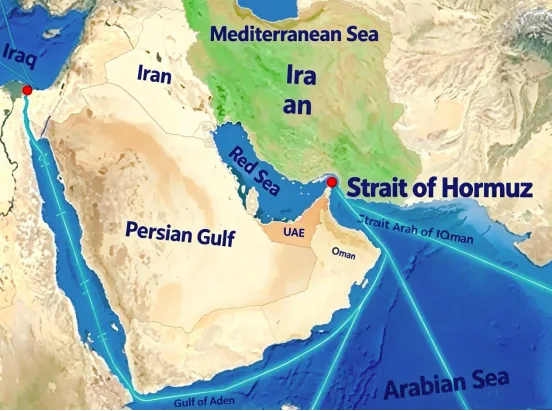
On February 28, 2026, following military strikes by the United States and Israel against Iran, tensions in the Middle East escalated rapidly, making the Strait of Hormuz a major focal point for global energy and commodity markets.
Iran announced restrictions on vessel traffic, prompting numerous oil and gas companies, shipowners, and traders to suspend or adjust shipments through the Strait of Hormuz.A February 28 Reuters report noted that although some vessels were still transiting the strait at the time, the risk of shipping disruptions had risen rapidly, and several major shipping companies had begun taking precautionary measures.
The impact of this crisis on the salt chemicals market is not simply a matter of “a Strait of Hormuz blockage leading to higher soda ash prices.” What warrants closer attention is how energy prices, production costs, ocean freight rates, insurance premiums, and supply chain adjustments are collectively affecting procurement costs and trade flows for certain salt chemical products.
closer attention is how energy prices, production costs, ocean freight rates, insurance premiums, and supply chain adjustments are collectively affecting procurement costs and trade flows for certain salt chemical products.
Escalating Strait of Hormuz Risks: Energy and Logistics Costs Come Under Pressure
The Strait of Hormuz connects the Persian Gulf to the Gulf of Oman and is one of the world’s most critical energy transport corridors. According to data from the U.S. Energy Information Administration, approximately 20% of global LNG trade passed through the strait in 2024, with about 83% of that volume destined for Asian markets, primarily China, India, and South Korea. Consequently, disruptions in the strait would first affect energy commodities such as crude oil, refined petroleum products, LNG, and LPG, before rippling through to the chemical industry through higher energy costs.
In March, the International Energy Agency (IEA) further noted that the conflict had brought shipping through the Strait of Hormuz to a near standstill, severely disrupting the transportation of approximately 20 million barrels per day of crude oil and petroleum products. The IEA described the disruption as one of the largest supply disruptions in the history of the global oil market. On March 11, IEA member countries also decided to release 400 million barrels from their emergency oil reserves to mitigate the supply shock. For salt chemical producers and buyers, this means that even if their products do not pass through the Strait of Hormuz, their energy and logistics costs may still be indirectly affected.
Soda Ash: Iran’s Exports Hindered, China Faces Oversupply
Among salt chemical products, soda ash is currently one of the most closely watched commodities. Iran is the world’s fourth-largest producer of soda ash, with a production capacity of approximately 4.5 million metric tons per year. According to public trade data, Iran exported approximately 307,200 metric tons of soda ash in 2024, primarily to India, China, and markets across Southeast Asia.
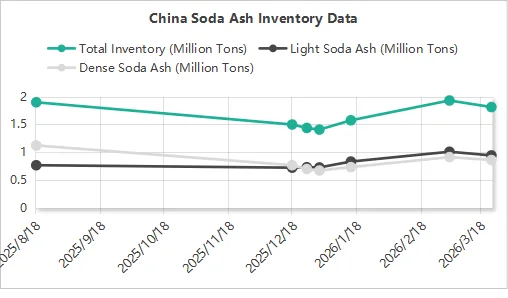
However, it is important to note that the Chinese soda ash market is currently facing a significant supply surplus. As of February 2026, China's soda ash production capacity had increased by 3.55 million metric tons to 44.65 million metric tons, with additional capacity expected to come online over the next two years. At the end of February, soda ash producers held total inventories of 1.8944 million metric tons, up 306,400 metric tons, or 19.29%, from February 12. Of this total, 998,500 metric tons were light soda ash and 895,900 metric tons were heavy soda ash. In February, the average ex-factory price of light soda ash in China was RMB 1,201 per metric ton, down 0.96% from January.
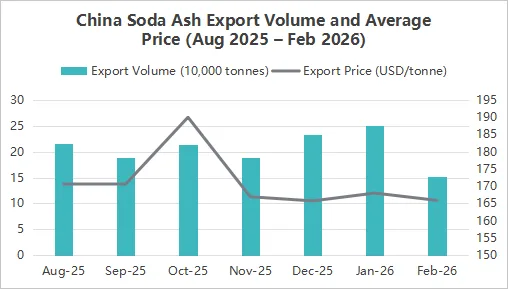
China exported 249,600 metric tons of soda ash in January 2026 at an average export price of $168.02 per metric ton. In February, exports fell to 152,200 metric tons, while the average export price declined to $165.90 per metric ton. Cumulative soda ash exports for January and February totaled 401,800 metric tons, up 39.06% year over year. However, February exports fell sharply by 39.03% month over month. This decline was primarily attributable to the Spring Festival holiday and seasonal logistics constraints rather than geopolitical factors.
Iran soda ash exports mainly serve regional markets including Iraq, Afghanistan, Turkey, India, China, and Southeast Asia. Any prolonged disruption could reshape the regional soda ash supply chain, although the overall global balance will still depend more heavily on China’s production capacity, inventory levels, and downstream demand..Therefore, the impact of Strait of Hormuz-related risks on soda ash is more likely to be reflected in regional price differentials and changes in international logistics costs. Soda ash prices in China will ultimately continue to depend on inventory levels, demand from the glass and photovoltaic sectors, and producer margins.
Caustic Soda: Limited Geopolitical Impact; Prices Return to Fundamentals
Compared with soda ash, the caustic soda market is less directly exposed to Middle East supply disruptions. However, because the chlor-alkali industry is highly energy-intensive, changes in electricity prices, natural gas costs, and transportation expenses can influence production economics and the global caustic soda supply chain. Total caustic soda production capacity in the Middle East is approximately 3.45 million metric tons, concentrated in Saudi Arabia, Iran, Egypt, and Turkey, which together account for about 3.5% of global capacity. According to Reuters data, Iran and Saudi Arabia are projected to export a combined 322,000 metric tons of caustic soda in 2025, accounting for about 3.0% of global caustic soda exports and only about 0.4% of total global supply.
This suggests that even if Iranian caustic soda exports were completely disrupted, the impact on the global supply-demand balance would be relatively limited. The primary drivers of caustic soda prices remain China's domestic alumina demand and chlor-alkali plant operating rates.
The chlor-alkali industry is highly energy-intensive; fluctuations in electricity, natural gas, and transportation costs can affect production and export pricing. If energy supplies from the Middle East continue to be disrupted, global energy prices and chemical production costs may become more volatile, increasing the marginal cost of caustic soda production in certain regions. However, this impact is indirect and limited in scope.
India Launches Soda Ash Import Investigation, Adding Uncertainty to Asian Trade
India is a key market for assessing how changes in Middle Eastern supply affect the Asian soda ash trade. India has long sourced soda ash from overseas markets, including Iran, and is itself a major global consumer of soda ash. Notably, India’s Directorate General of Trade Remedies (DGTR) launched a safeguard investigation into soda ash imports on March 16, 2026, covering imports from all countries of origin. This means that the Asian soda ash market is now being shaped not only by shipping risks in the Strait of Hormuz, but also by changes in import policies, shifts in supply sources, and regional trade competition.
Conclusion
Overall, shipping disruptions in the Strait of Hormuz are unlikely to trigger a broad-based increase in salt chemical prices directly. Instead, they are more likely to amplify existing market pressures through changes in energy costs, logistics, and trade flows. Soda ash will face the dual pressures of geopolitical risks and trade policy changes, while caustic soda prices will continue to be driven primarily by downstream fundamentals. All parties along the industrial chain should not rely solely on FOB quotes; instead, they should incorporate supply chain stability, comprehensive landed costs, and trade policy risks into their core assessment frameworks and develop diversified procurement plans to navigate a market environment marked by multiple overlapping uncertainties.