
In November 2025, U.S.-China trade tensions entered a period of easing. The United States withdrew its threat of additional tariffs on Chinese goods, reduced some tariff rates, and extended exemptions for certain Section 301 tariffs. These changes provided a more predictable trade environment for companies involved in chemical imports from China, particularly buyers in the U.S. salt chemical market.
China-U.S. Leaders Meet in Late October as Tariff Adjustments Take Effect
The United States had previously announced plans to impose additional tariffs on Chinese imports starting November 1, raising procurement costs and increasing uncertainty for U.S. importers. On October 30, the Chinese and U.S. leaders met in Busan, South Korea. Following the meeting, the two sides reached a series of interim arrangements covering tariffs, rare earths, and export controls. On November 4, the U.S. President signed an executive order formally implementing the relevant commitments.
The adjustments included three key measures:First, the U.S. reduced the tariff imposed on Chinese goods under its fentanyl-related tariff measures from 20% to 10%, effective November 10. Second, the additional 24% reciprocal tariff remained suspended for another year, and the 10% baseline reciprocal tariff remained in effect until November 10, 2026. Third, exemptions from certain Section 301 tariffs were extended for another year. On November 26, the Office of the U.S. Trade Representative (USTR) further announced that it would extend Section 301 tariff exemptions for 164 categories of industrial and medical products, as well as 14 categories of solar manufacturing equipment, until November 10, 2026.
China has also adjusted its countermeasures accordingly. According to an announcement by the Tariff Commission of the State Council, effective November 10, China would continue suspending the additional 24% tariff on U.S. imports for one year, while the 10% rate will remain in effect.
Actual Tariff Impact on Chinese Salt Chemical Products Entering the U.S. Market
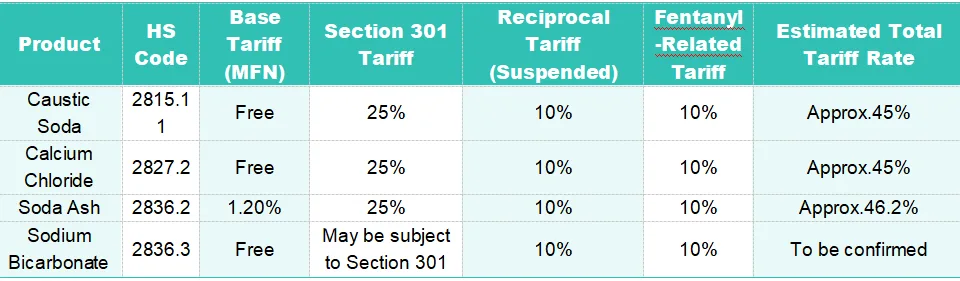
For U.S. buyers working with a Chinese chemical supplier, a broad reduction in tariffs does not mean that all products will benefit equally. The actual tariff treatment for products such as soda ash, caustic soda flakes, calcium chloride, sodium bicarbonate, and sodium nitrite must be determined on a product-by-product basis according to the applicable HS code and the U.S. tariff policies in effect at the time.
The November trade arrangements reduced the risk of further tariff hikes in the short term and gave Chinese suppliers greater certainty when quoting prices and negotiating contracts for the U.S. market. For products such as caustic soda, calcium chloride, and soda ash, the 25% Section 301 tariff remains a significant cost burden, and the direct tariff relief from the November adjustments is limited.
Tariff Reductions Did Not Immediately Trigger a Rebound in Exports
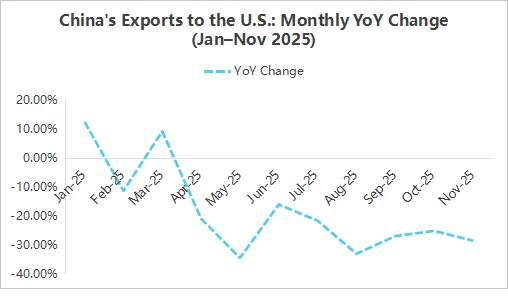
In November 2025, China’s exports to the U.S. fell 28.6 percent year-over-year, with the decline widening by 3.4 percentage points compared to October. From January through November, China’s cumulative exports to the U.S. dropped 18.9 percent year-over-year, marking the eighth consecutive month of double-digit declines.
This trend runs counter to the tariff reduction, primarily for three reasons: First, the front-loading effect had begun to fade. Faced with the threat of further tariff hikes, some U.S. importers placed orders in advance to stockpile goods, thereby drawing down future demand. Second, trade flows typically respond to policy changes with a time lag.The tariff adjustments took effect on November 10, but order confirmation, production scheduling, and logistics arrangements take time, so the recovery in actual trade volumes lags behind policy changes. Third, U.S. inventory levels remained under pressure. Following the conclusion of the U.S.-China talks in Kuala Lumpur, overall end-user demand in the U.S. has remained weak, and short-term pressure to reduce inventory persists.
The weak performance of China’s exports to the United States in November suggests that an improved tariff environment does not automatically translate into an immediate recovery in trade flows. The impact must first pass through contract negotiations, order placement, production, and logistics before it is reflected in actual shipment volumes.
U.S. Imports of Calcium Chloride and Sodium Bicarbonate Show Structural Divergence Following Tariff Adjustments
Following the easing of U.S.-China trade tensions, calcium chloride and sodium bicarbonate have been among the salt chemical products showing notable changes in U.S. import activity.
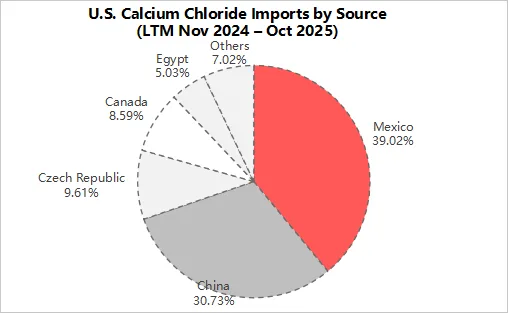
Calcium chloride is a product for which the United States has significant import demand. According to GTAIC data based on UN Comtrade, in the 12 months ending October 2025, U.S. imports of calcium chloride (HS 2827.20) totaled $81.5 million, with an import volume of 186,200 metric tons. Mexico accounted for 39.02% of imports, while China accounted for 30.73%, making China the second-largest source of calcium chloride imports for the United States.
Imports of calcium chloride from China continued in November 2025. On November 27, a shipment of approximately 40 metric tons of calcium chloride arrived at the Port of Oakland, while a shipment of approximately 200 metric tons of anhydrous calcium chloride arrived at the Port of New Orleans on November 24.
These shipments indicate that, despite the lack of a fundamental change in the tariff structure, U.S. demand for Chinese calcium chloride remains relatively resilient in applications such as industrial processing and de-icing. However, calcium chloride remains subject to a significant Section 301 tariff burden, so the November policy changes have had only a limited impact on its overall tariff costs.
For U.S. importers, the more immediate benefit is a reduction in policy uncertainty rather than a significant decline in landed costs. A recovery in Chinese calcium chloride exports to the U.S. is therefore more likely to take the form of renewed long-term contract negotiations and more stable ordering patterns than a sharp short-term increase in import volumes.
For sodium bicarbonate, the tariff burden in the U.S. market is relatively lower, and certain product categories may qualify for Section 301 tariff exclusions. In November 2025, China’s sodium bicarbonate exports totaled 100,700 metric tons, up 12.14% month over month and 31.48% year over year. Net exports reached 94,600 metric tons.
China is one of the world’s largest producers and exporters of sodium bicarbonate, with a market share of more than 25%, while the United States and European markets together account for nearly 45% of global demand. With the improvement in the tariff environment, sodium bicarbonate is likely to show greater import responsiveness than calcium chloride.
As for baking soda, the tariff burden on the U.S. market is relatively light, and some product categories may even be included on the Section 301 exemption list. In November 2025, China’s total sodium bicarbonate exports reached 100,700 metric tons, up 12.14% month-over-month and 31.48% year-over-year, with net exports totaling 94,600 metric tons. China is the world’s largest market for sodium bicarbonate, accounting for over 25% of the global market share, while the U.S. and European markets combined account for nearly 45%. Following improvements in the tariff environment, baking soda exhibits greater import elasticity than calcium chloride.
Conclusion
The easing of U.S.-China trade tensions in November reduced policy uncertainty but did not fundamentally change the tariff cost structure for salt chemical products.For U.S. importers, the key change is not an immediate reduction in tariffs across the board, but a more predictable trade policy environment. Calcium chloride continues to be supported mainly by relatively inelastic demand, while sodium bicarbonate has greater sensitivity to changes in import costs and market conditions.As the market adjusts, cooperation between U.S. buyers and experienced industrial chemical suppliers will become increasingly important, especially for products such as calcium chloride, sodium bicarbonate, soda ash, and caustic soda flakes.