
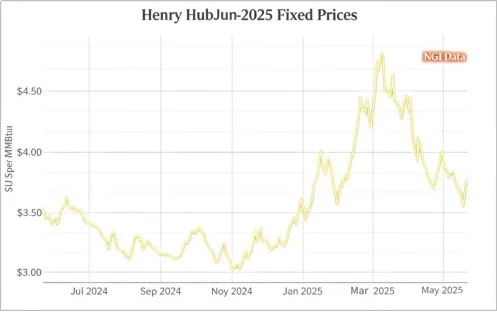
In June 2025, U.S. natural gas prices experienced significant volatility. According to market data released by the American Gas Association on June 20, the Henry Hub near-month futures settlement price rose to $3.99/MMBtu on June 18—a 13.7% increase from a week earlier and the highest level since early April. As of June 16, the monthly average spot price at the Henry Hub was $2.84/MMBtu, approximately 9% lower than the May average. During the same period, the average Henry Hub futures price was $3.64/MMBtu, 5.3% higher than in May. The Henry Hub forward price for June was $3.398/MMBtu and is expected to remain at $3.724/MMBtu for the remainder of the summer.
Natural gas prices not only affect the U.S. energy market but also impact the chemical industry through fuel costs, electricity costs, and industrial production costs. However, since the production processes for different salt chemical products vary, their sensitivity to natural gas prices also differs significantly.
In the U.S. market, caustic soda and chlor-alkali production are relatively sensitive to energy costs, while the impact on calcium chloride depends on the specific production pathway. The cost transmission mechanisms therefore differ across products.
Caustic Soda and Chlor-Alkali: Natural Gas Accounts for Up to 70% of Costs
Caustic soda is produced via the chlor-alkali electrolysis process. Together with chlorine, it constitutes the electrochemical unit (ECU), the industry's standard measure for production costs. An ECU represents 1 metric ton of chlorine and 1.1 dry metric tons of caustic soda. Chlor-alkali production is inherently electricity-intensive, and natural gas prices primarily impact costs through fuel and electricity expenses. In the U.S., natural gas comprises approximately 70% of ECU production costs.
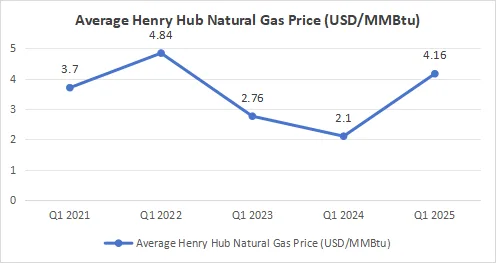
The rise in natural gas forward prices in June placed substantial pressure on the cost structure of chlor-alkali producers. In its Q1 2025 earnings report, Westlake Corporation stated that the company “faced pressure from high ethane and natural gas prices this quarter,” with profit margins in its North American polyethylene business coming under particularly significant pressure. The company's costs for natural gas, ethane, and other NGL feedstocks in the Americas reached record highs in Q1, with the average Henry Hub natural gas price for the quarter at $4.166 per MMBtu, compared to just $2.163 per MMBtu during the same period in 2024.
From a global competitive perspective, however, the U.S. chlor-alkali industry continues to benefit from a relatively abundant domestic natural gas supply. Argus noted that U.S. natural gas prices still offer a cost advantage compared to European natural gas benchmarks, helping U.S. chlor-alkali producers maintain strong cost competitiveness.
Calcium Chloride: Production Pathway Determines Energy Cost Sensitivity
Calcium chloride production primarily relies on co-production via the combined soda-ammonium process and the ammonia-soda process. In the ammonia-soda process, calcium chloride is a byproduct of soda ash production, recovered from distillation waste liquid. In the combined soda-ammonium process, calcium chloride is also produced as a co-product. Natural gas plays a dual role as an energy source and a feedstock in both processes, and price increases directly drive up overall production costs.
Companies using the combined soda-ammonium process, however, receive policy incentives on natural gas prices. This process produces approximately 1 metric ton of ammonium chloride for every 1 metric ton of soda ash produced. Because ammonium chloride is used as a fertilizer, companies employing this process receive price discounts on natural gas, electricity, and transportation, which partially offsets the impact of rising natural gas prices. However, these discounts primarily apply to Chinese producers. In the United States, calcium chloride production relies mainly on the recovery of waste liquid from the ammonia-soda process, making it more sensitive to natural gas price fluctuations.
From the perspective of downstream demand, calcium chloride prices rose 1.45% month-over-month in June, supported by stable local supply, rising freight costs, and resilient industrial demand. However, national construction spending fell by 0.3%, with private residential activity declining by 0.8%, limiting the scope for further price increases. The dual pressure of rising costs and weak demand caused calcium chloride producers' profit margins to narrow in June.
Soda Ash: The Natural Soda Ash Process Reduces Sensitivity to Energy Prices
Compared to the chlor-alkali process, the energy consumption structure of U.S. soda ash production is significantly different.
U.S. soda ash production primarily employs the natural soda ash process, using trona resources from the Green River Basin in Wyoming as the main raw material. The natural soda ash process is relatively simple, and its energy consumption per unit is lower than that of synthetic methods such as the Solvay process. As a result, U.S. natural soda ash producers have long maintained strong cost competitiveness.
Public industry data shows that energy consumption for soda ash production via the natural soda ash process in the U.S. is approximately 4 to 6 MMBtu per metric ton, whereas the Solvay process and China's Hou process consume approximately 10 to 14 MMBtu per metric ton.
This implies that, all other things being equal, rising natural gas prices have a relatively limited direct impact on the production costs of soda ash produced via the natural soda ash process. Natural soda ash resources and lower energy consumption per unit reduce the U.S. soda ash industry's sensitivity to energy price fluctuations.
On June 24, 2025, ChemAnalyst reported that the U.S. soda ash market was operating stably, with production activities in Wyoming proceeding normally and U.S. soda ash exports remaining steady. The agency also noted that stability in the U.S. market is further supported by domestic demand and logistics conditions.
Therefore, while the U.S. soda ash market has remained stable during periods of rising natural gas prices—a stability that cannot be entirely attributed to the low energy consumption of the natural soda ash process—lower energy consumption does reduce producers' direct exposure to changes in natural gas prices.
Conclusion
Price fluctuations at the Henry Hub in June 2025 reflect differences in cost structures among various U.S. salt chemical products.
Caustic soda and chlor-alkali production are relatively sensitive to energy costs, and natural gas prices can affect production costs through fuel and electricity expenses. The extent of the impact on calcium chloride depends on the specific production pathway and energy mix and cannot be generalized using a single cost ratio. U.S. soda ash production is dominated by the natural soda ash process, and its lower unit energy consumption results in relatively low direct sensitivity to changes in natural gas prices.
Therefore, rising natural gas prices do not affect all salt chemical products in the same way. When assessing future price changes, producers and buyers should not only monitor the Henry Hub but also analyze specific product production processes, energy mixes, supply conditions, and downstream demand.