
On January 3, 2026, the U.S. military launched an operation codenamed “Absolute Resolve” against Venezuela, deploying more than 150 military aircraft to conduct strikes in Caracas and detain President Maduro. La Guaira, Venezuela’s main port, was severely damaged in the attack, bringing oil exports to a complete standstill. This event represents a major geopolitical development in the Western Hemisphere and has triggered renewed concerns over global commodity markets and chemical supply chains. As the country with the world’s largest proven oil reserves and a major mineral exporter in Latin America, the sudden upheaval in Venezuela not only directly impacts the supply and demand of core commodities such as energy and non-ferrous metals but will also reshape the global commodity markets through ripple effects across industrial supply chains.
Crude Oil: Short-Term Supply Disruptions and Long-Term Market Restructuring
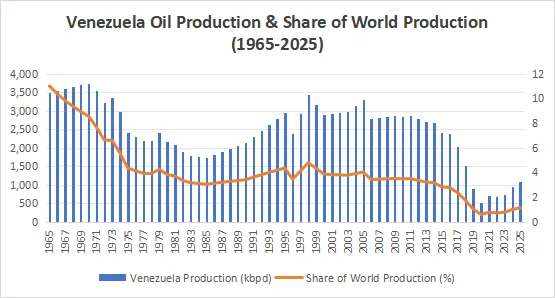
Venezuela holds 17% of the world’s oil reserves (approximately 303 billion barrels). Although its current average daily production stands at only 1.1 million barrels (accounting for 1% of global output), the unique value of its heavy crude oil to global refineries makes it a critical factor in global crude oil markets. Following U.S. military operations, the José Terminal—Venezuela’s main port—has come to a complete standstill, preventing oil tankers from loading and departing. Coupled with the saturation of storage tanks and floating storage facilities, production cuts are likely if storage capacity remains constrained and export disruptions continue. In the short term, the supply gap in heavy crude will directly drive up oil prices. Venezuela’s “Merey 16” crude is a preferred feedstock for producing high-quality paving asphalt and is well-suited to the processing needs of refineries along the U.S. and Mexican Gulf coasts. The disruption of its exports will force refineries in Asia, Europe, and the United States to seek alternative feedstocks, driving up prices for downstream products such as diesel and fuel oil. U.S. crude oil prices could move toward the $60 per barrel level in the short term, while domestic SC crude oil and asphalt futures are expected to strengthen in tandem. However, in the long term, if the U.S. gains control of Venezuela’s oil resources, American companies such as Chevron and ConocoPhillips will significantly increase their involvement to repair aging facilities. In the medium term, Venezuelan crude exports are expected to approach 3 million barrels per day, while OPEC+ holds 5.2 million barrels per day in spare capacity, which can gradually fill the gap. Oil prices will then return to being driven by supply-and-demand fundamentals and may even come under downward pressure due to oversupply. It is worth noting that Canadian heavy crude producers may face increased competitive pressure, as Venezuelan crude could challenge their traditional position in North America, and the scarcity premium on oil sands profits may be eroded.
Precious Metals: Safe-Haven Demand and Dollar Market Dynamics
Even before the U.S. launched the operation, the Venezuelan bolívar had been depreciating steadily (down 83% year-over-year against the U.S. dollar this year), sparking market concerns about emerging market currency depreciation and inflation, which further reinforced the safe-haven appeal of precious metals. Supported by accommodative monetary conditions and market liquidity, precious metals surged before the holiday but then retreated; following the holiday, a strengthening geopolitical premium may serve as a new market driver.
In addition to direct safe-haven buying, this event has also sparked market concerns about resource supply risks. Venezuela itself possesses substantial gold reserves and production capacity, and the incident highlights the U.S. policy approach toward resource-rich countries in Latin America, which could threaten the flow of trade in critical minerals, thereby adding a layer of supply risk premium to gold and silver prices. However, this bullish effect will be constrained by two fundamental factors: First, gold and silver have already risen significantly in 2025 and are trading near historic highs, creating pressure for profit-taking in the market; second, prior to the outbreak of this incident, factors such as a strengthening U.S. dollar and rising U.S. Treasury yields had caused gold prices to correct rapidly, and market sentiment remains divided between bullish and bearish factors.
Non-Ferrous Metals: Energy Costs and Geopolitical Risks Shape Market Expectations
Although Venezuela possesses abundant resources such as bauxite and iron ore, its share of global mineral production remains low due to long-standing factors such as insufficient investment and infrastructure constraints.
Aluminum has attracted the most market attention among non-ferrous metals. Venezuela once had a relatively complete aluminum production system, but in recent years, aluminum production has remained at relatively low levels. In 2024, Venezuela’s exports of aluminum-related products totaled approximately $314 million, representing a small proportion of the country’s total exports. Furthermore, China has not imported bauxite or primary aluminum from Venezuela in recent years; therefore, the impact of the Venezuela situation on global aluminum supply fundamentals is limited. However, as aluminum is an energy-intensive metal, if geopolitical risks drive up crude oil prices, bunker fuel costs, and regional energy costs, this could provide support for aluminum prices through the production cost channel.
As for iron ore, nickel, and copper, Venezuela is not a major global supplier, so the direct impact on supply is minimal. In 2024, Venezuela’s iron ore production was approximately 2.4 million metric tons, representing a small share of global output; exports of nickel and copper were similarly limited. Consequently, prices for these metals are more likely to be influenced by market risk sentiment, shipping costs, and overall commodity volatility.
Overall, the events in Venezuela have had a limited direct impact on the supply chains of non-ferrous metals, with price effects primarily transmitted indirectly through energy costs, shipping risks, and market sentiment. However, it is worth noting that the U.S. attack on Venezuela has triggered changes in the geopolitical landscape of South America. The medium- to long-term impact will depend on the extent to which the conflict damages infrastructure and mining operations in key mining regions (such as the Guiana Shield region in the southeast). If regional conflicts continue to escalate, they could reduce the marginal supply of key metals such as bauxite, iron ore, and even copper on a global scale.
Agriculture: Energy and Shipping Costs Drive Fluctuations in Grain Prices
Venezuela is not a major agricultural exporter. The country has limited domestic food production capacity and relies heavily on imports. Food imports exceeded $3 billion in 2024, while exports mainly consist of cash crops such as coffee and cocoa. Therefore, the event is unlikely to directly alter global supply and demand fundamentals for major agricultural commodities such as wheat, corn, and soybeans.
However, the incident may have an indirect impact on the agricultural sector through the “energy–transportation–cost” chain. First, fluctuations in crude oil prices may drive up agricultural production costs. Oil is not only a key fuel source for agricultural machinery but also a vital raw material for fertilizer production. If energy prices continue to rise, this could increase the cost of agricultural inputs such as nitrogen fertilizers, which would then be passed on to grain cultivation costs, thereby supporting the prices of major agricultural commodities like wheat, corn, and soybeans. Second, heightened shipping risks in the Caribbean and Latin America may disrupt logistics for South American agricultural exports. Countries such as Brazil and Argentina are major global exporters of soybeans and corn; if regional transportation costs increase or shipping routes are adjusted, this could lead to longer export cycles, higher freight rates, and increased procurement costs for importing countries.
Conclusion
This marks the first “black swan” event of 2026. Although tensions had been building over the previous six months, the speed of the U.S. response and the rapid escalation of events surprised market participants. From a global political and economic perspective, the event has raised further concerns about the resilience of existing international cooperation mechanisms. increasing concerns over fragmentation in global trade and supply chains. Together with other resource supply policy changes, including Indonesia’s nickel ore quota adjustments and export-related measures, these developments have reinforced concerns over supply constraints, rising costs, and risk premiums across global commodity markets.
Looking ahead to 2026, the commodities market will continue to be shaped by multiple factors, including energy market volatility, U.S. fiscal conditions, monetary policy changes, geopolitical tensions, and shifts in global trade patterns. For chemical producers and commodity buyers, managing supply chain resilience and procurement flexibility will become increasingly important in navigating a more uncertain market environment.